

MNEK, Grime and the Gay Elephant in the Room
MNEK's "REVERSE!!" was set to be the ultimate gay reimagining of a grime classic. But at the final hour a denied sample clearance raised bigger questions. Who gets to inherit Black British music and when will we finally embrace the queer roots of our culture? Writer Saint Adams dives into Black freedom, queer constraint and the history of UK garage.
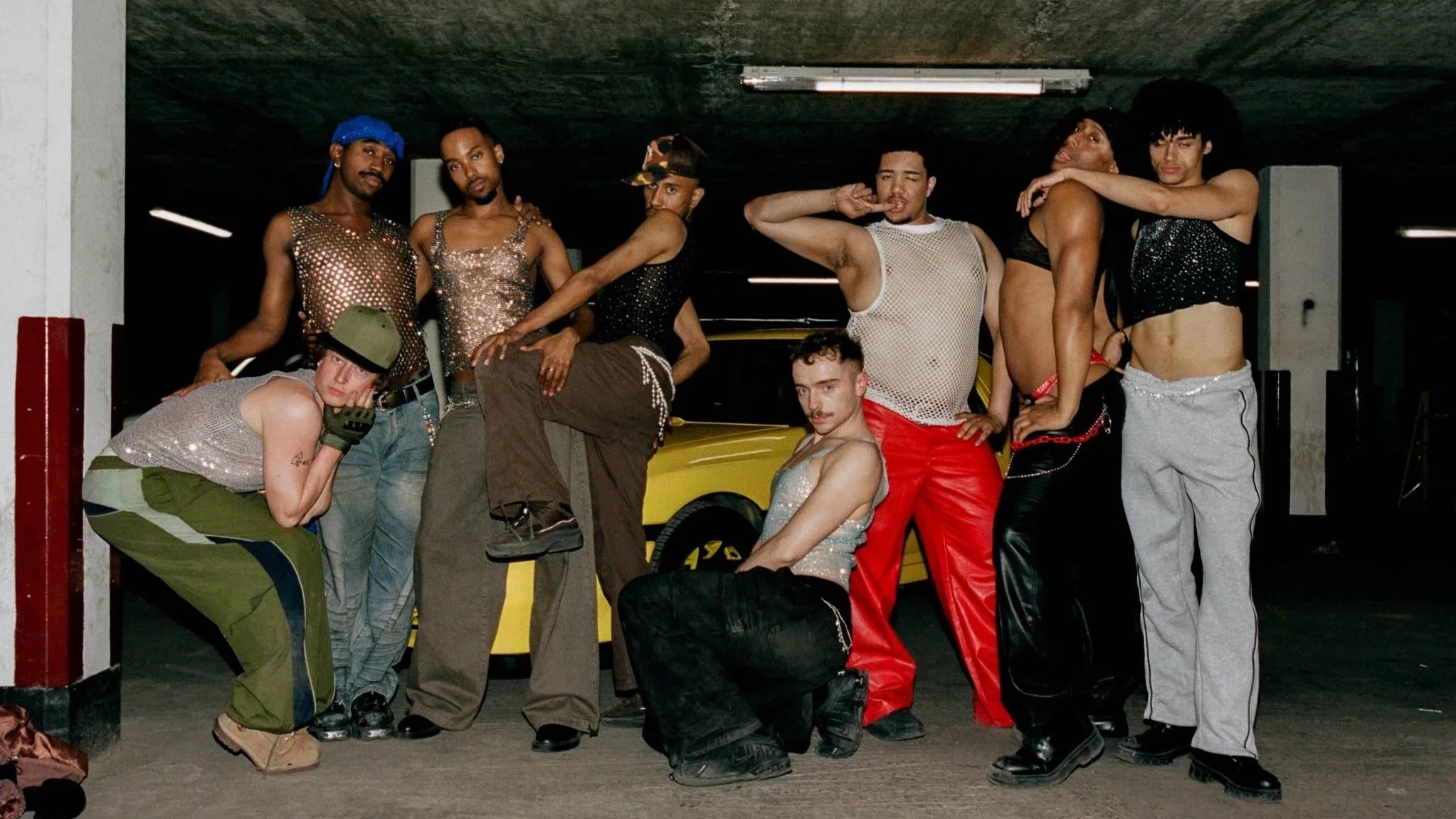
BTS shot of the dancers from MNEK's "REVERSE" music video. Image property of Danté Richardson.
Am I in shock at why the producers of Lethal Bizzle's grime classic "Pow! (Forward)" would deny sample clearance to a two-time Grammy-nominated producer who has worked on five UK top 10 singles, and with Madonna, and with Beyoncé? Of course not. MNEK's "REVERSE!!"—a track that could be classified as grime pop and aggressively gay—illustrates the embodied authorship that has defined his contribution to pop music over the last decade, but also the growing mainstream opportunity now available to queer male artists.
Since MNEK's first solo album Language in 2018, pop music has seemingly become more tolerant to the concept of a fully embodied queer male pop artist, both in sound and aesthetic. Lil Nas X's post-COVID MONTERO era introduced a new contemporary gay visual grammar to mainstream pop culture—the cultural significance of songs "CALL ME BY YOUR NAME!" and "INDUSTRY BABY" and their videos proved the commercial viability in overtly queer male pop. This oscillated into the successes of Sam Smith's subversive anthem "Unholy" in 2022 and Troye Sivan's table-shaking third studio album Something to Give Each Other in 2023.
And with collaborative successes with artists like FLO and Zara Larsson, MNEK has certainly proved he has the technical and sonic skillset to re-emerge into solo stardom in his own right. It's perhaps no surprise, then, that his return would begin by reaching back to the sounds that first made him.
"REVERSE!!" is less an exercise in nostalgia than an act of authorship, positioning MNEK as one of the few artists capable of translating South London's grime and garage heritage into the language of contemporary pop. If South London has produced some of Britain's most influential musical talent, MNEK stands among its most complete creative exports.
The truth is there are very few artists better placed to reinterpret South London's musical inheritance into a pop sensibility than MNEK. Who, after all, is doing it like him? Yet the difficulty in clearing its central "Pow!" sample places limitations upon that authorship.
The gag is the homophobia behind "Pow! (Forward)" not being cleared is actually quite…unremarkable. Homophobia exists within Black British communities—shocker—but I do giggle at the historical irony of it all.
The irony that a grime artist—an agent of a genre spurred out of garage, which was named after the NYC gay nightclub Paradise Garage (1978 - 1987)—is uncomfortable with his sonics existing alongside queer expression… when grime is an evolution of Black queer sonics… alongside Black masculine expression.
“I can make a thug really twerk,
I can make a thug really switch, call it Uzo reverse,
I can turn his duffel to a purse...
I can make a thug really cry,
Make a hood classic sound like a sweet lullaby.”
In 1994, at a house party in Greenwich, DJ EZ dropped Todd Edwards' "The Praise (God in His Hands)" at around 130 BPM; roughly ten beats per minute faster than its original recording. A watershed moment in dance music's transatlantic evolution, British producers took that influence—alongside the practice of speeding up American garage records and elements from jungle, rave and bass culture—and created UK garage (UKG).
But before then, garage house was a more soulful, gospel-influenced iteration of house, developed in the New York-New Jersey club scene. It was the resident DJ of New York's Paradise Garage, Larry Levan, who married the spiritual ecstasy of the Black Church with the liberation of the gay dancefloor. Drawing from gospel and dub, his cult Saturday Mass sets were transmitted through the club's meticulously engineered sound system, pioneering the garage sound.
In reverence of garage house, US innovator DJ Todd Edwards would reconfigure it into speed garage, introducing syncopated rhythms to soulful vocal fragments. This became the foundation of UK garage.
Eventually, with the permeating influence of dancehall, dub and soundsystem culture in British Caribbean communities, UKG evolved into a darker sound. Following the turn of the millennium, emcees became more central and instruments more aggressive, stripping garage of its more soulful character. This "dark garage" becomes grime.
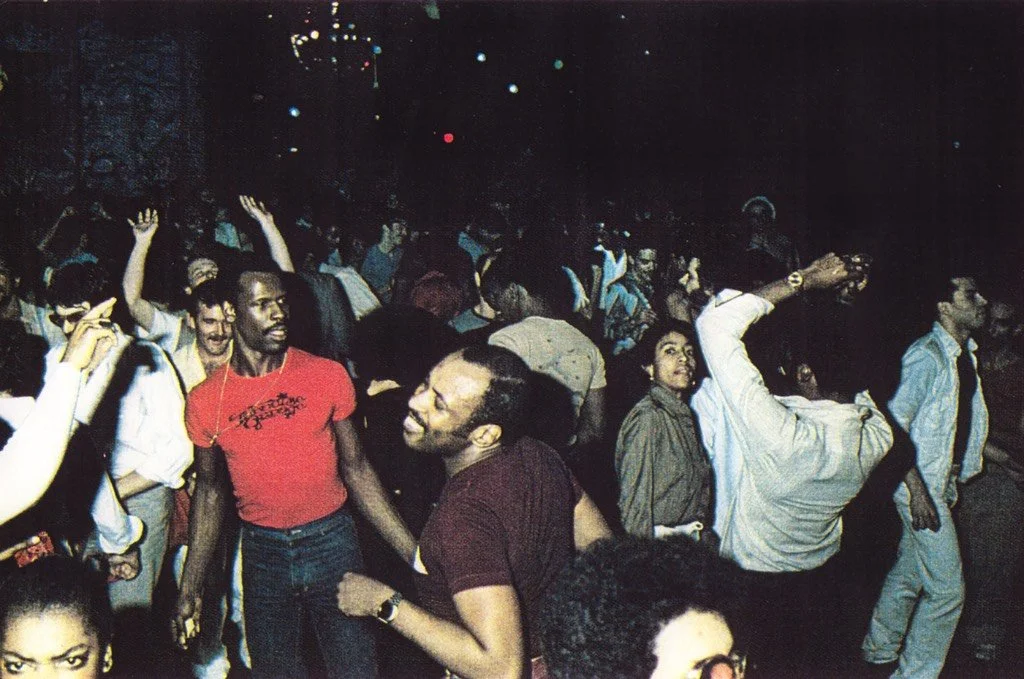
The dancefloor of iconic New York City nightclub Paradise Garage in 1979. Image property of Bill Bernstein.
This lineage doesn't make grime straightforwardly a queer genre, or a genre that has ever staked a claim in the (queer) radical potential of garage house. However, if genre, form and expression is found through cultural exchange, migration and adaptation, then the denial of MNEK's queer reimagining of grime is more than just a tale of cultural gatekeeping. It is in fact antithetical to the very act of being an artist and participating in culture creation.
What can be truly transgressive and radical in Black British music (particularly from male artists) if cultural and musical inheritance can't be freely reimagined into something new? More concerning than the fate of one sample is the wider question of which Black British male pop identities are afforded the freedom to shine.
And it's made more prevalent with the rise of "UK poo"—a new online pejorative which ultimately mirrors UK youth audience's "ick" at ambition-in-progress, but also the parameter that male artists uniquely face due to rigid coding around masculine expression. This paradigm is even evident in what we can consider our contemporary classics.
“Black musical cultures have long been shaped by queer Black creativity... At what point does the selective adoption of queer cultural expression become a form of appropriation in its own right?”
In his triumphant mixtape Black British Music (2025), Jim Legxacy does make an impressive claim as the new David Bowie, illustrated by his sonic mastery, drawing influences from rap, indie and pop. Yet any true Bowieism ultimately stops at the music. Legxacy shows a conspicuous reluctance to extend that same artistic abandon into his visual grammar, which remains indebted to the nonchalance and familiar signifiers of contemporary Black British masculinity.
But this is largely on the audience too, who in their tastes and discourse also reinforce how far an artist can go. This reflects a sociology of identity and how the Black British man is policed even within the realm of pop culture.
Danger lies in a culture willing to celebrate queer sonic vocabularies while withholding that same generosity from queer embodiment itself. It also forces us to reconsider cultural appropriation through a different racialised lens.
If Black musical cultures have long been shaped by queer Black creativity, what does it mean when these sonic vocabularies are embraced, while queer Black artists themselves remain constrained? At what point does the selective adoption of queer cultural expression become a form of appropriation in its own right?
It is a contradiction that becomes particularly striking when placed alongside the viral success of Che Mario's hit track "U Da Cake" this summer. Whilst not by any means an overtly queer song, the record is built heavily around musical elements from US ballroom culture that have been enthusiastically embraced by Black mainstream audiences.
"U Da Cake" fuses ballroom sonics with gqom and dancehall. Yet, I do wonder how many audiences are truly aware of the history and musical traditions in ballroom, which these communities fight staunchly to protect to prevent erasure?
I could easily see "U Da Cake" becoming a formative influence to the direction of Black British pop making… and I can already see where this can go completely awry. What happens when ballroom crashes, performance cues or lingo become ordinary features of Black British pop? Do they cease to be read as queer? Do they become naturalised into a different masculine code?
That process of naturalisation has already extended beyond music, evident in fashion. Black male style has become increasingly comfortable with forms of embellishment and flamboyance that, removed from their heterosexual masculine context, would hardly appear alien within Black queer visual culture.
Take the recent rise in the "shiny shokoto": rhinestone-covered trousers and shorts increasingly worn by young Black men. The joke may be that the trousers are gaudy and excessive, but there is another irony sitting underneath it—aesthetically, Black men are increasingly dressing in ways that would not look particularly out of place on a butch queen.
Yet once those same aesthetic codes pass through streetwear and contemporary Black masculinity, what is queer at its core is, at most, read as "sassy". The clothes remain flamboyant; the wearer is simply afforded a different masculine reading.
This raises the same question as ballroom's movement into Black British music: when queer aesthetics become ordinary enough to stop being recognised as queer, who gains the freedom produced by that transformation—and whose freedom is lost?
“More concerning than the fate of one sample is the wider question of which Black British male pop identities are afforded the freedom to shine.”
The contradiction is that Black British music has always advanced through cultural exchange, yet the artists and audiences inheriting those exchanges remain constrained in how fully they are permitted to embody them. MNEK's denied sample clearance is simply the clearest expression of that contradiction.
Now, can the onus purely be placed on the team behind "Pow! (Forward)" for not wanting their sample used on an lyrically explicit song about topping DL trade? Of course not. And maybe MNEK attempting to build a bridge between queer and Black British musical traditions is one that was perhaps always destined to be contentious.
However, the lasting legacy of "REVERSE!!" could be that it exposed how Black music-makers and listeners err the risk of being ahistorical; of stifling the radical potential of music and eroding the foundation that Black British music innovation was built upon.
MNEK's new album BULLDOZER!! drops September 18th. In the meantime, stream "REVERSE" below: