

Should the Revolution Be Televised?
From Compton to San Juan, Halftime Shows have become significant cultural events. An interesting trend has emerged: they serve as a high-stakes platform for political protest. But how far can these protests go when they operate within an ideological state apparatus?
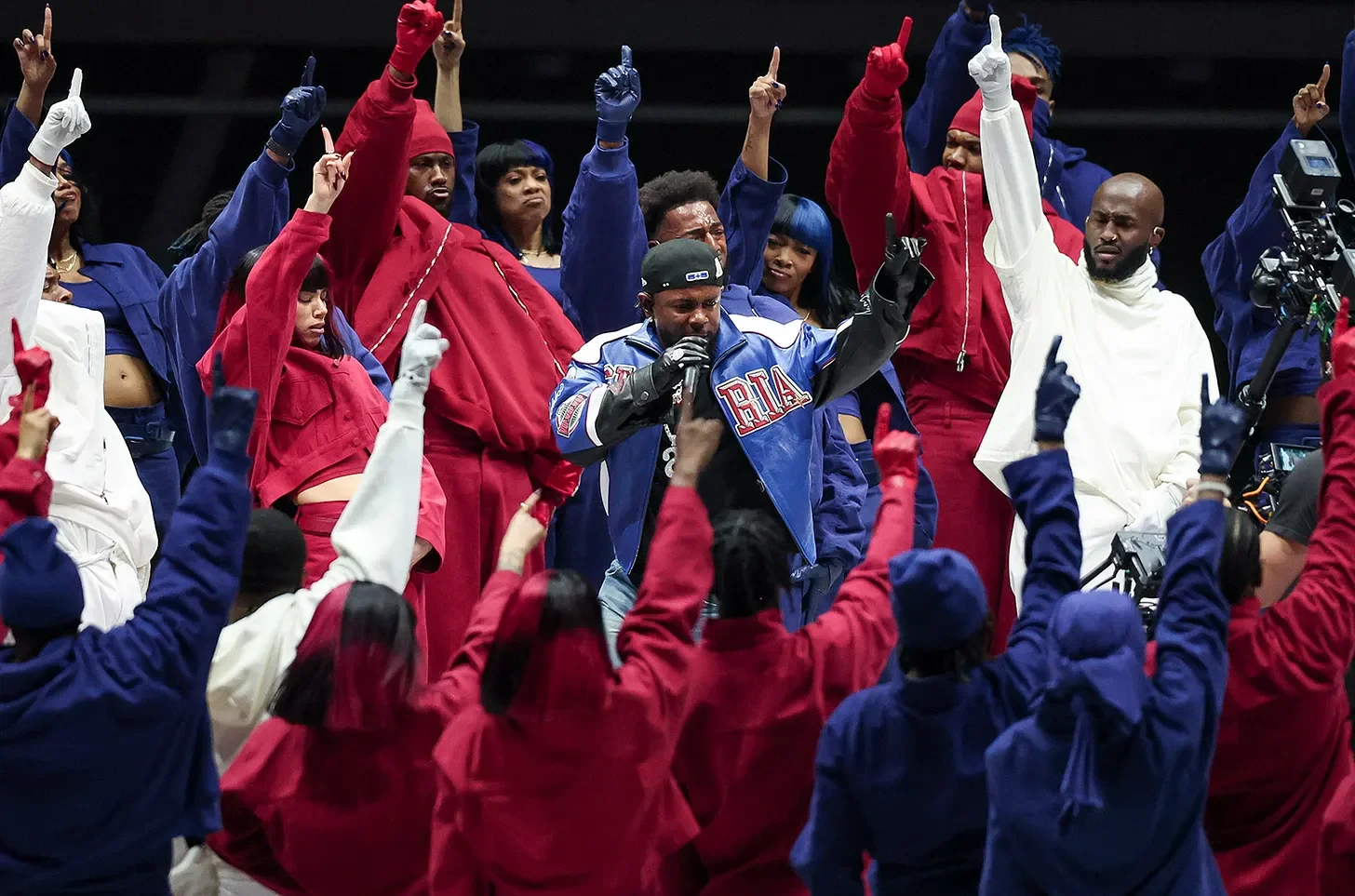
Kendrick Lamar at the Apple Music Super Bowl LIX Halftime Show. Image property of Christopher Polk and Getty Images.
Picture this: Olympic Games, Mexico, 1968. Tommie Smith and John Carlos, two African-American athletes, have just won gold and bronze, respectively. They're atop a podium, collecting their medals, when the US national anthem begins to play; slowly, both their fists rise, their heads bow—and they remain that way 'til the anthem's finished. A photo is taken that lasts a lifetime. Launching yourself into the political landscape is a daunting undertaking, all the more so when it comes at the risk of your livelihood.
Sports and politics seem to attract each other everywhere we look, all the time; whether it be the Knicks losing game three of the NBA Finals, coincidentally the one game that Trump attended, or the myriad of political issues and sentiments that have come from The World Cup, hosted this year in North America; with numerous players, coaches, officials and fans being denied entry to the U.S.A. Furthermore, Iran's involvement in the tournament has been consistently curtailed by the governing bodies, who are all cosying up to the state's leader in any way possible.
Historically, sport has been a huge vehicle for political protest: whether it be Didier Drogba and the Côte d'Ivoire int'l team helping to stop the Ivorian Civil War, Allen Iverson's torchlight on the use of respectability politics within NBA basketball, or Colin Kaepernick kneeling through the national anthem. As long as publicised sport has existed, it has been used to send a message.
This landscape, I feel, stands similarly to the music world: how one makes a stand through performance, whether that be an athletic or vocal one. I remember hearing Nina Simone's "Why? (The King of Love is Dead)", her ode to Martin Luther King Jr., who had been shot dead a few months prior.
The first time I heard the song was, of course, decades after its release, decades after the death of MLK, yet still felt mystifyingly heartbreaking, when she intones: "Will my country fall, stand or fall? Is it too late for us all? And did Martin Luther King just die in vain?"
It was only a matter of time after sports and music intertwined that the political statements would come tenfold. We've seen the "Halftime Show" become something of a regularity these days; tournaments like the World Cup and the NBA Playoffs have dipped their toes into platforming artists as the teams take a break, but the Halftime Show most famously originated from one place it still holds close: the Super Bowl.
Beginning as a showcase for marching bands, the Super Bowl faced dwindling numbers during the Halftime show every year until 1993, when they announced none other than Michael Jackson as the Halftime performer, kicking off what we know today as the Halftime Show. He brought the house down, and everyone followed suit.
"Dearly beloveds, we're gathered here today to get through this thing called life" were the first words out of Prince's mouth at Super Bowl XLI in 2007. He appeared on stage, as he'd always been there, guitar draped around his neck. Rain thundered down, in the most unpleasant display of weather we've seen at a Super Bowl. He launches seamlessly into "Let's Go Crazy", dressed in an ever-so-slightly SpongeBob-esque suit.
“I remember Don saying, ‘Put me on the phone with Prince.’ Now, Don says, ‘I want you to know it’s raining,’ and Prince is like, ‘Yes, it’s raining.’ [Don said], ‘And are you okay?’ And Prince goes… ‘Can you make it rain harder?’”
Both the rain and the stage seem easy for him to handle; he saunters across it in high heels, reaching the crowd and intoning "someone take my picture with all this rain". Prince played both a few of his own songs and covers of both Bob Dylan and Foo Fighters, something of a rarity without the cameo to match it.
Prince tops this all off with a beautiful performance of "Purple Rain", one that feels like the sum of all its parts—a culmination of all the effort and beauty he's taken part in. Fireworks launch from the roof of the stadium, and Prince lifts his guitar into the air, as if it's the very trophy both teams are out there fighting for.
Okay, Ladies, Now Let's Get In Formation
Not many people remember that Beyoncé performed at the Super Bowl in 2013. Not to say the performance was unremarkable; it was incredible, in fact: everything we've come to expect of Beyoncé, excellence and perfectionism on a scale near Michael Jackson. This forgetting isn't actually to do with quality at all, but an upstaging.
Beyoncé upstaged herself just three years later, in a performance not many people remember wasn't hers. The reins were actually given to Coldplay in 2016, for Super Bowl 50. I won't pretend I'm much of a Coldplay fan, but one has to recognise a good performance when they see it: and this was exactly that. They played all the songs you would expect, with "Viva La Vida", "Paradise" and "Adventure of a Lifetime". Mark Ronson and Bruno Mars then interrupt the performance with "Uptown Funk", dressed in black leather, which is then further overtaken by a marching band.
Drummers all move to reveal none other than Beyoncé, surrounded by dancers draped in black leather and berets, in direct reference to the uniform worn by The Black Panther Party, who marked their fiftieth anniversary in the same year. Beyoncé holds her fist up, and erupts into her song "Formation".
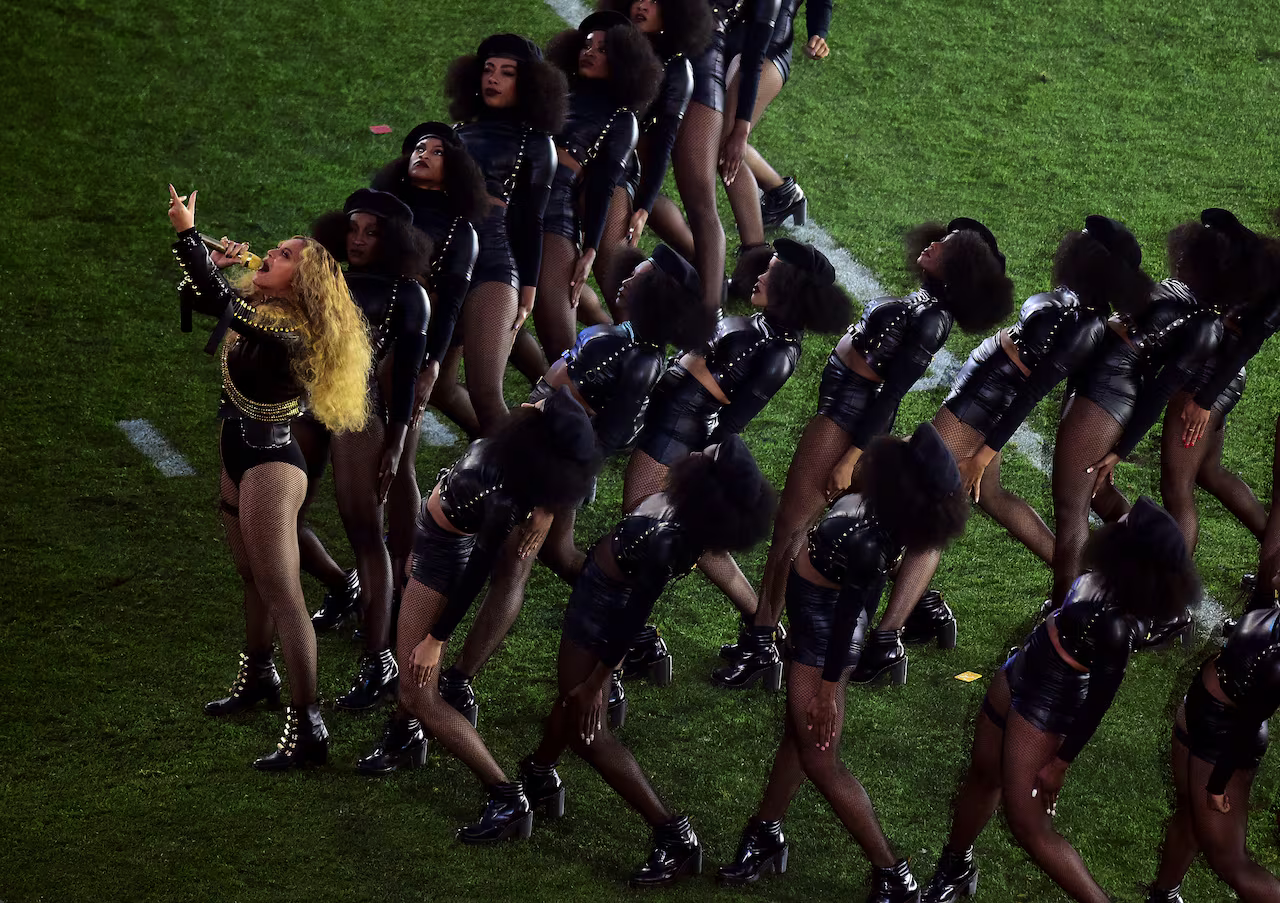
Beyoncé at the Super Bowl 50 Halftime Show. Image property of Harry How and Getty Images.
"Formation" in itself is a resistance song; a counter-narrative based celebration of Black, American woman-ness. The whole thing is an inherent celebration of her lineage, her politics, her culture—"I like my baby heir with baby hair and afros". The album it's from, Lemonade, is Beyoncé's most political and feminist—an album where she takes shots at her own husband's infidelity.
In the video for the song, Beyoncé crouches atop a sinking New Orleans police cruiser, invoking the politics of Hurricane Katrina and the disproportionate effect it had on the Black population of the city. By the end of the video, the cruiser is completely submerged in the dark waters, taking Beyoncé into the deep with it.
When Beyoncé performs "Formation" at the Super Bowl, the day after it released, in a surprise performance, I see someone taking their platform in stride. I doubt the average Beyoncé fan would have these lyrics memorised in that turnaround, so there was no fan-service in play—it was her choosing to make a statement.
This performance is a challenge to the status quo. Up until this point, Beyoncé was arguably easily-consumable; her story of former pop group standout with Destiny's Child, to her solo excellence, becoming the world's biggest pop star, left her widely-beloved, and easy to root for. "Formation", and furthermore Lemonade, caused outrage in its release and performance. In the days following the Super Bowl, former mayor of New York City, Rudy Giuliani, commented that the performance was an "attack" on police officers, and complaints to the television programmer likened her performance to the KKK and lamented about "racist hand gestures".
In his 2013 text, Graffiti in Tehran, Shahram Khosravi writes, "Graffiti in Iran, as elsewhere, is […] a struggle between political authorities and consumerism, on one side, and youth counterculture on the other. Graffiti expresses the reclaiming of what has been neglected, denied and rejected in the past three decades […] Graffiti, like political demonstrations, is a way to express one's presence, one's being there".
In her Super Bowl performance, Beyoncé is reminding the world of Black, cultural existence and perseverance. It's an inherent work of counterculture, representing a refusal of silence and palatability. It's a reminder, an expression of presence, in the most publicised space, for the world to see.
This is Bigger Than The Music
Kendrick Lamar first appears atop a Buick GNX, lamenting "The revolution 'bout to be televised, you picked the right time but the wrong guy" before launching into "Squabble Up". Not many had a year like Lamar in 2024; after a rap beef with Drake, not only had he come out on top (all whilst calling his adversary a paedophile), but he'd created one of the most successful songs of all time.
"Not Like Us", the final blow of the battle, became the fastest rap song to reach one hundred million streams, and was the most streamed song of that year. A few months after, Lamar released his sixth studio album, GNX, which swept the Grammys, with a total of five wins.
All of this considered, it's not exactly surprising that he was picked for the Super Bowl Halftime Show in 2025, even if there was some controversy following the selection. When February 9th came around, any qualms had been settled, with 133.5 million people tuning in, the most viewed Halftime Show to date. It's an absolutely fantastic performance, focusing more on the symbolic than Beyoncé's of years past.
Constantly interrupting the performance, Samuel L. Jackson, dressed in a full star-spangled suit, plays the role of Uncle Sam. Throughout the performance, Jackson bemoans "No, no, no… too loud, too reckless, too…. ghetto." Here, Lamar is using the platform to play with the visibility of Afro-Caribbean American culture in popular media. The word "ghetto" is key, a semiotic trigger of stereotype, which often associates Black people, more specifically Black women, with negative code and connotation.
After performances of Lamar's most successful songs, "Luther" and "All The Stars" with collaborator SZA, Samuel L. Jackson comments, "That's what America wants, nice and calm". Then, after conjuring more Compton culture, he comments, "Oh, I see you brought your homeboys with you… the old culture cheat code". Kendrick Lamar pre-empts media critiques and, in a way, disarms them. He chooses to invoke the codes he knows will be put upon him.
Lamar, born and raised in Compton, has dancers dressed in both blue and red, representing the 'Crips' and 'Bloods', two publicised Compton-based gangs. He uses this platform to challenge mainstream media's gaze, what Helaan E. Page refers to as the "national seeing I/eye", a construction of understanding based on media tropes and representation, one that disproportionately assumes an "inherent wrongness or obvious guilt of the African-American man" (1997). By using red/blue in his performance, he's challenging their negative media representations, offering a new light, a new code.
Later in the performance, the camera pans to fellow Compton-native Serena Williams, "C-walking" on stage, in an active narrative-reclamation. It's a reference to the 2012 Olympics, when Serena was lambasted with hate and criticism for performing the dance after her gold-medal win over Maria Sharapova. Columnists and spectators suggested it was "deviant" and that it "glamourised gang violence".
Williams was often met with semiotic-racialised codes of "ghetto" and "aggressive" throughout her career. By taking the stage at the Super Bowl, Serena Williams is retroactively reclaiming agency and performing resistance, both in 2012 and in 2025. Later that night, Williams commented, "Man, I did not crip walk like that at Wimbledon… I would've been fined."
The Cost of This Stage
Every year, as another artist takes the stage and displays resistance through their performance, a question stays present: When performing through the most capitalist site possible, one that actively participates in war, is revolution actually achievable? Furthermore, was it ever revolutionary in the first place?
As reported in 2015, the U.S Department of Defence spread $5.4 million of taxpayer money across fourteen NFL teams, in order to put on "patriotic displays", honouring the military and veterans through their 'Salute to Service' scheme.
In the year Kendrick Lamar performs at the Super Bowl, the NFL opted to have the words "End Racism" removed from the end zones of each playing field. I can't say we should attach ourselves to symbolic semiotic gestures without the real work to match, but one has to question intention here; in an organisation littered with a history of racialised controversy within owners and coaches, in a league where players are blacklisted for their own political gestures and performances, you have to question if this is the stage to find revolutionary movement, or if it's even, possibly, problematic.
“Go Beyoncé go, watch the fighter jet fly high, war machine gets glamourised, we play the game to pass the time. Go, Kendrick, go, watch the fighter jet fly high, war machine gets glamorised, we play the game to pass the time.”
I think I find myself most conflicted when asking these questions of myself. I wouldn't ever be able to bring myself to say these performances are useless. In fact, we just spoke on narrative disruption; of taking an expectation and using it to disrupt the status quo with all the more impact. This resistance through performance is hard, careful work, and these artists took their time in the (literal) spotlight to disrupt, decode and protest. One can question the organisation it's done through, the lens it's presented within, but cannot discredit them completely.
The Next Year: Bad Bunny and Closing Sentiments
Benito Antonio Martínez Ocasio's selection for the Super Bowl should hardly have come as a surprise. The artist, known as Bad Bunny, has consistently ranked among the world's biggest artists since 2020, particularly outside the US. Following the record-breaking success of his album DeBI TiRAR MaS FOToS, he was an obvious choice for the role. There was one factor that made his selection especially significant: Ocasio performs entirely in Spanish and hails from Puerto Rico.
His appointment consequently sparked debate among those who believed the role should be filled by an English-speaking American. The performance also arrived during a period marked by authoritarianism, as ICE agents flooded American streets, with immigration enforcement disproportionately affecting people of Latin American origin.
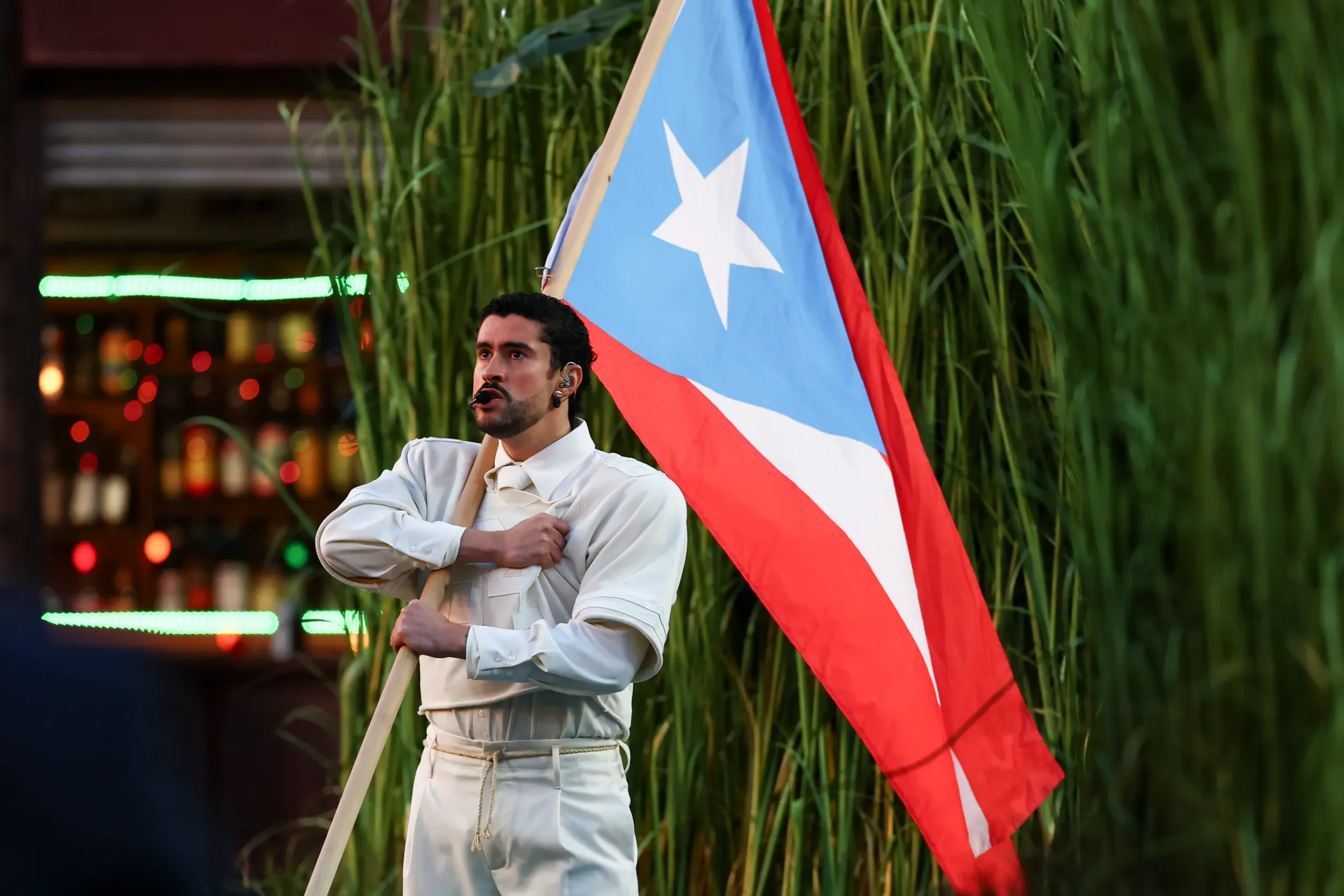
Bad Bunny at the Super Bowl LX Halftime Show. Image property of Kevin Sabitus and Getty Images.
The performance opens in a sugarcane field, a reference to an industry that once played a significant role in Puerto Rico's economy. The opening songs take a similarly symbolic approach to Kendrick Lamar's recent Super Bowl performance, using visual imagery to communicate a broader political message.
Ocasio's staging confronts the history of Puerto Rico's colonisation, first under Spain and later under the United States. He eventually performs atop electrical power lines, referencing the island's long-running struggles with its power infrastructure. Puerto Rico experienced the longest electrical blackout in American history following Hurricane Maria in 2017. The flag draped across Ocasio's back is also significant: it is Puerto Rico's independence flag, created before US involvement and later altered to reflect the colours of the American flag.
The NFL might not be the organisation you want to align yourself with whilst trying to create a protest. It's almost endlessly critiquable, but the Super Bowl Halftime Show provides you with the ultimate audience, so I cannot pretend to be blind to the appeal of disrupting the narrative on the biggest stage possible.
Later in the show, the "Tití Me Preguntó" singer takes a more Beyoncé-esque approach. He shouts, "God bless America!" before naming (almost) every country across Central, Southern and Northern America. An ensemble follows, each member holding a different national flag. Benito begins to run, carrying a ball that reads 'Together, we are all America'. Behind him, a huge LED screen reads, "The only thing more powerful than hate is love".
Benito then throws the ball to the ground and breaks into his most popular song, "DtMF", which is chanted throughout the stadium. The song translates to "I should've taken more photos when I had you […] I hope my people never move away", and this is something, I suppose, everyone can relate to, but all the more when you live somewhere with your people disappearing from the streets every day, where your relatives could leave the house, never to return.
Watch Bad Bunny's Super Bowl LX Halftime Show performance here.