

The Enduring Legacy of 'Afro Samurai'
Nearly three decades after its creation, the cult franchise series remains a fascinating example of what can happen when different cultural traditions meet.
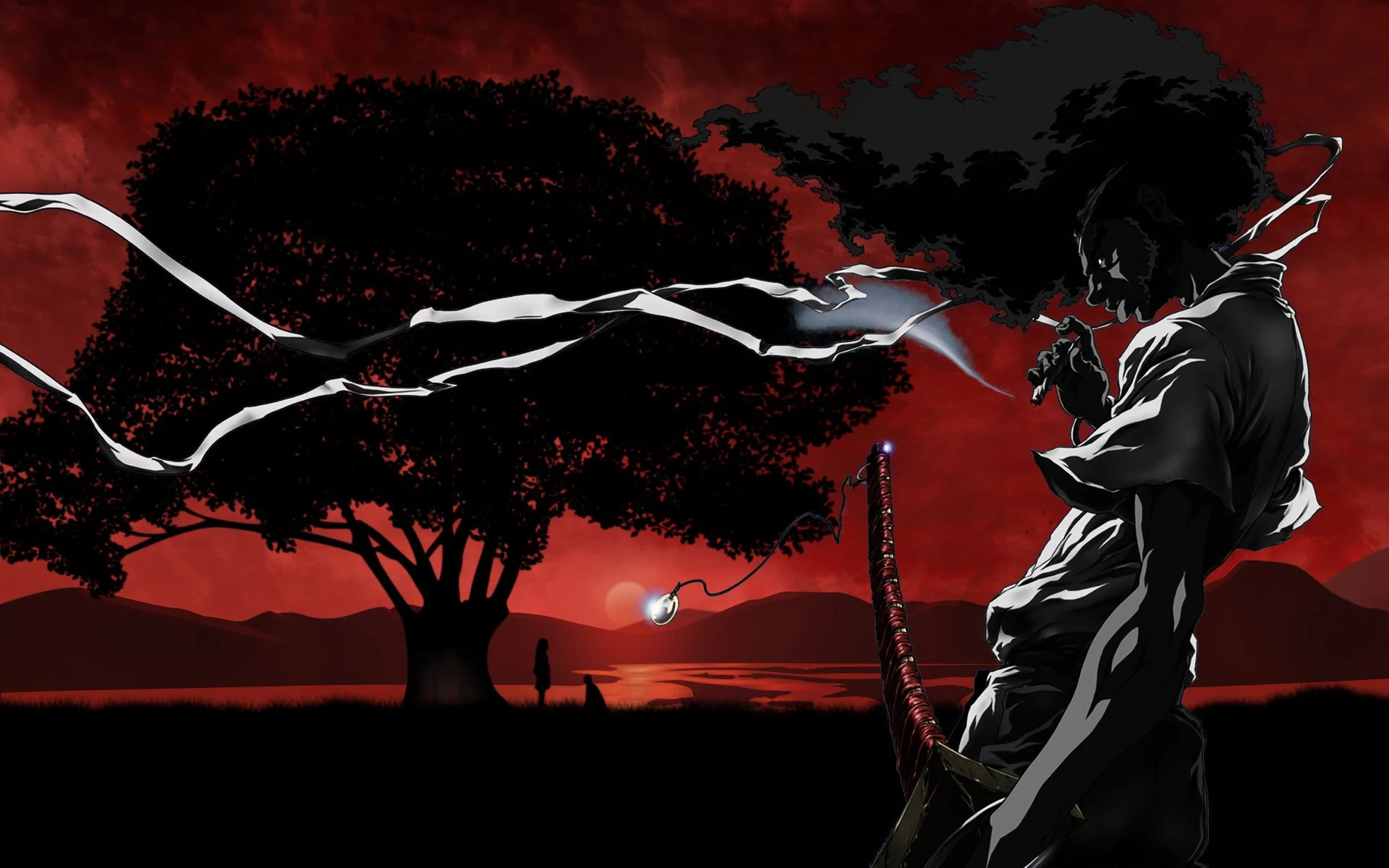
Afro Samurai artwork. Image property of Takashi Okazaki, Gonzo K.K. and Crunchyroll.
Drawing on hip-hop, soul, samurai cinema and manga traditions, the Japanese series Afro Samurai emerged from a unique collision of influences and histories. The series began as a doujinshi (a self-published manga) in the late 1990s, created by Japanese artist Takashi Okazaki, described as an anime and hip-hop crossover. While technically true, that description feels far too neat for a project that was never really interested in staying within clearly defined boundaries.
Okazaki has explained in the past how he drew inspiration from hip-hop, tracing his creative education through artists like Public Enemy, De La Soul and J Dilla, alongside soul and funk records, Soul Train reruns, blaxploitation films, samurai cinema and manga. In many ways, Afro Samurai was built using the same creative logic that underpins hip-hop itself: sampling-pulling inspiration from different places and different histories before reshaping them.
The story follows Afro, a Black swordsman seeking revenge against Justice, the gunslinger responsible for killing his father. The story's premise was straightforward, but the context surrounding it was anything but.
Imagery of Feudal Japan existed alongside futuristic technology and advancements, while traditional samurai mythology collided with Afrofuturist imagery. Characters moved through landscapes that felt simultaneously ancient and futuristic, familiar and strange.
From the beginning, Afro Samurai wore its influences openly. While Okazaki has spoken about his love of hip-hop and Black American music, academics and critics have since highlighted the longer history of exchange between Japanese and African American culture that made a character like Afro possible. Rather than simply borrowing from Black culture, it feels more like a conversation between both, with the result occupying a space that felt both new and exciting for audiences.
That sensibility remained intact when the project made the leap from manga to television in 2007. The anime adaptation arrived with two collaborators who, in hindsight, feel almost inevitable. The first was Hollywood powerhouse Samuel L. Jackson.
In addition to voicing one of the show's main characters, Jackson also acted as an executive producer and became one of the project's key advocates. This role is reminiscent of his work as an executive producer on the cult classic 1997 gothic thriller, Eve's Bayou, in which he also starred. At a time when anime still occupied a relatively niche space in Western popular culture, his involvement immediately expanded the series' reach. Audiences who may never have picked up a manga or watched an anime suddenly had a reason to pay attention.
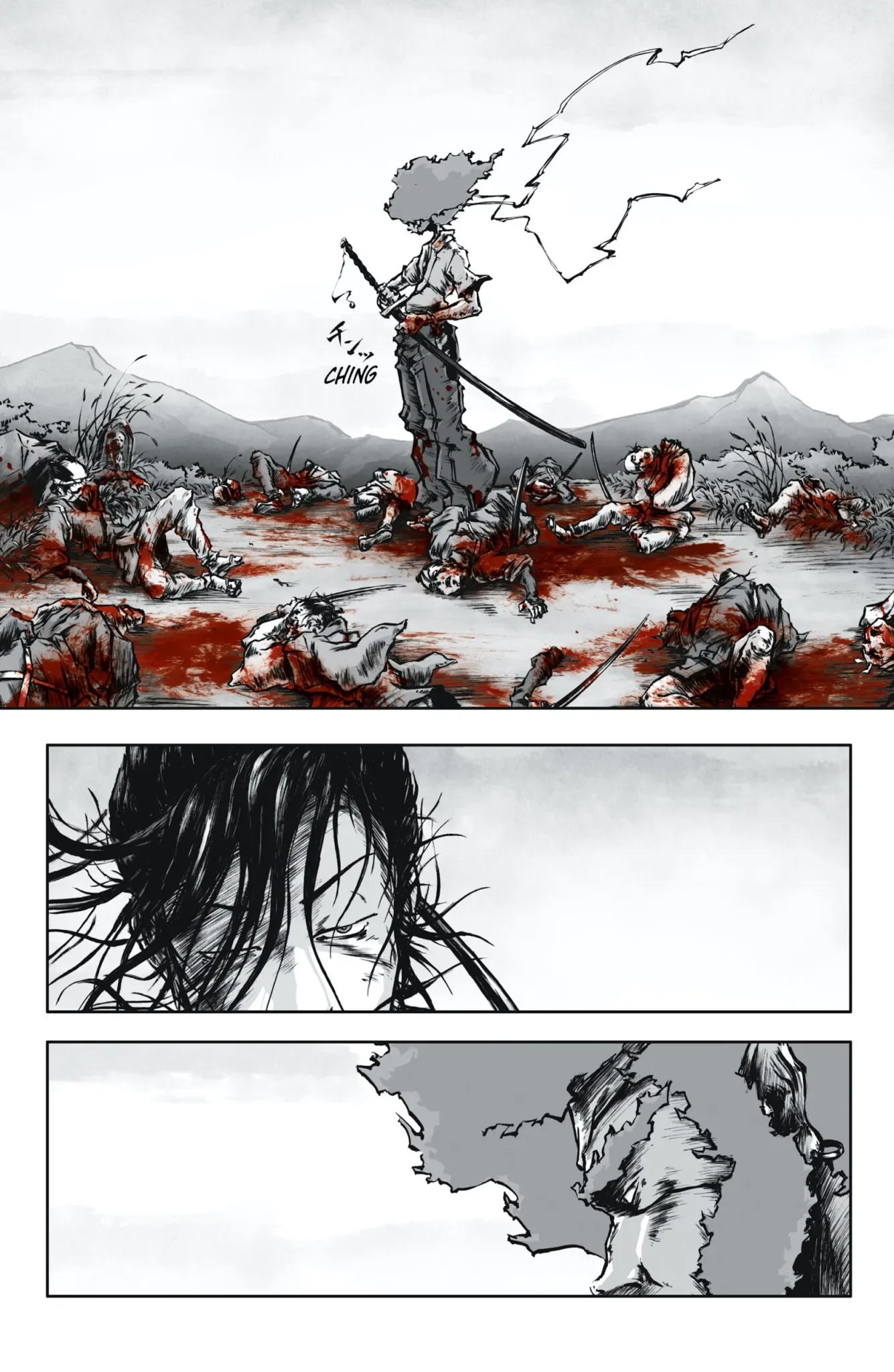
A manga excerpt. Image property of Takashi Okazaki.
His dual performance as both Afro and Ninja Ninja remains one of the most memorable aspects of the adaptation. Where Afro is largely silent, stoic and emotionally guarded, Ninja Ninja is loud, vulgar and impossible to ignore. The character functions as comic relief, conscience and hype man all at once, speaking the thoughts Afro refuses to express. Debate remains around whether Ninja Ninja reinforces or satirises familiar stereotypes of Black masculinity, but perhaps his lasting significance lies in the fact that he complicates them.
The series centres Blackness while also questioning the ways Blackness is performed, consumed and understood. That distinction mattered—at a time when Black protagonists remained relatively uncommon across both anime and gaming, Afro wasn't a supporting character or comic side note. The mythology revolved around him. His grief, his rage and his contradictions sat at the centre of the story.
The second key collaborator was RZA. If Jackson helped introduce Afro Samurai to wider audiences, RZA helped define how it sounded. Much has been made of the connection between Afro Samurai and hip-hop, but framing RZA's involvement as the moment hip-hop entered the project misses the point. Hip-hop was already there. What RZA provided was a musical language capable of articulating the world Okazaki had built.
For decades, hip-hop artists had drawn inspiration from martial arts cinema. RZA's own Wu-Tang Clan transformed kung-fu dialogue, Shaolin mythology and samurai philosophy into core elements of their identity. Afro Samurai simply reversed the process. Here was a Japanese creator who had absorbed hip-hop, producing a story that RZA immediately recognised because it emerged from much of the same DNA that had shaped his own work.
“‘Afro Samurai’ is an example of it being big on the front stage, it takes creative artists to have that bravery. You saw it happen with ‘Blade’, you saw it happen with ‘Black Panther’. Somebody has to step forward and show the world that audiences are ready for it.”
The soundtrack became one of the defining features of the series. Soul samples, hard drums and cinematic arrangements sat alongside sword fights and futuristic landscapes, creating a world where none of those elements felt out of place.
As expected from a RZA media project (cough, Ghost Dog: The Way of the Samurai), music was integral to the storytelling. That becomes even clearer when viewed through some of the themes running beneath the surface of the narrative.
Throughout the series, Afro's father is associated with soul and funk traditions, while Justice, the white gunslinger who kills him, arrives accompanied by rock-inflected imagery and sounds. Whether intentional or not, the conflict echoes a much longer story about ownership, appropriation and cultural inheritance. The revenge narrative at the centre of the story is personal, but it also feels symbolic.
Afro Samurai's success paved the way for future anime productions aimed at Western audiences and demonstrated that anime could succeed on mainstream television with the right cultural adaptation and star power. The series showed that Japanese and African American cultural elements could be meaningfully fused rather than simply juxtaposed. By the end of the decade, Afro Samurai had grown beyond both manga and television.
Afro Samurai: Resurrection arrived in 2009, expanding the story with a larger cast that included Lucy Liu and Ron Perlman, while retaining the visual identity and musical sensibilities that had made the original series distinctive. It also made history as the first Japanese-animated production to receive and win a Primetime Emmy Award, claiming the Outstanding Individual Achievement in Animation award. That same year, Afro also leapt into the gaming world.
This is often treated as a footnote in the franchise's history, but it deserves more attention than it usually receives. For many people, particularly those coming of age during the PlayStation 3 and Xbox 360 era, the game—a third-person blade brawler centred on agile combat and the series' stylised martial-arts aesthetic—was their first encounter with the IP.
It also arrived at a moment when Black protagonists remained relatively uncommon in major video games, following the PlayStation 2 era's golden years of Black-led, hip-hop-heavy games such as Get on da Mic, 50 Cent: Bulletproof, the Def Jam series and Grand Theft Auto: San Andreas.
The game expanded the audience while also deepening some of the ideas explored in the series. Questions around identity, trauma and representation became more prominent, while Ninja Ninja's role evolved in increasingly strange and self-aware directions. Like the manga and anime before it, the game refused to settle into a single interpretation.
By the time Afro Samurai reached Britain, anime, gaming and music culture were already woven into the creative lives of a generation of young people. It appeared on Bravo, arrived through Manga Entertainment releases and featured at anime conventions during the late 2000s. In 2009, Afro Samurai: Resurrection even received a special screening in Shoreditch in London that brought together anime fans, gamers, DJs and graffiti artists under one roof and feels like an appropriate image for a franchise that had always thrived at the intersection of different scenes.
Its presence can also be found in the Black British music scene. The late British icon Black the Ripper released a mixtape dubbed Afro Samurai in 2008. Equally, beloved Essex rhymer Joe James would use the title for a single of his own more than a decade later, and Onoe Caponoe folded the imagery into his ever-expanding psychedelic universe. The references are sporadic rather than constant, but they continue to surface throughout the scene. Across the Atlantic, the influence has surfaced in US rap too: Lupe Fiasco's 2024 LP Samurai features a track called "No. 1 Headband", named after the series' coveted Number One Headband artefact.
Perhaps that is why Afro Samurai continues to resonate nearly three decades after it first appeared on the page. Across anime, manga, video games and soundtracks, the series has continually sliced its way through pop culture, leaving an imprint on each medium it entered. At its core was a process of cultural sampling: bringing different traditions, histories and influences into conversation while allowing each to retain its character.
Like the records that reared it, Afro Samurai took familiar sounds and stories, rearranged them and transformed them into something entirely its own, and it's a legacy that continues to endure.
Watch Afro Samurai here.