

To Catch a Culture Vulture: Why Does Hip-Hop Refuse to Learn Its Lesson from White Rappers?
Hip-hop falls down when it allows White voices to drown out its Black roots. The viral frenzy surrounding rapper Sunshine Benzi is just another example of White-washed Minaj-esque hip-hop mimicry—but she's just one of many. Her existence is a comment on the culture at large, and Sayou Cooper has a lot to say about it.
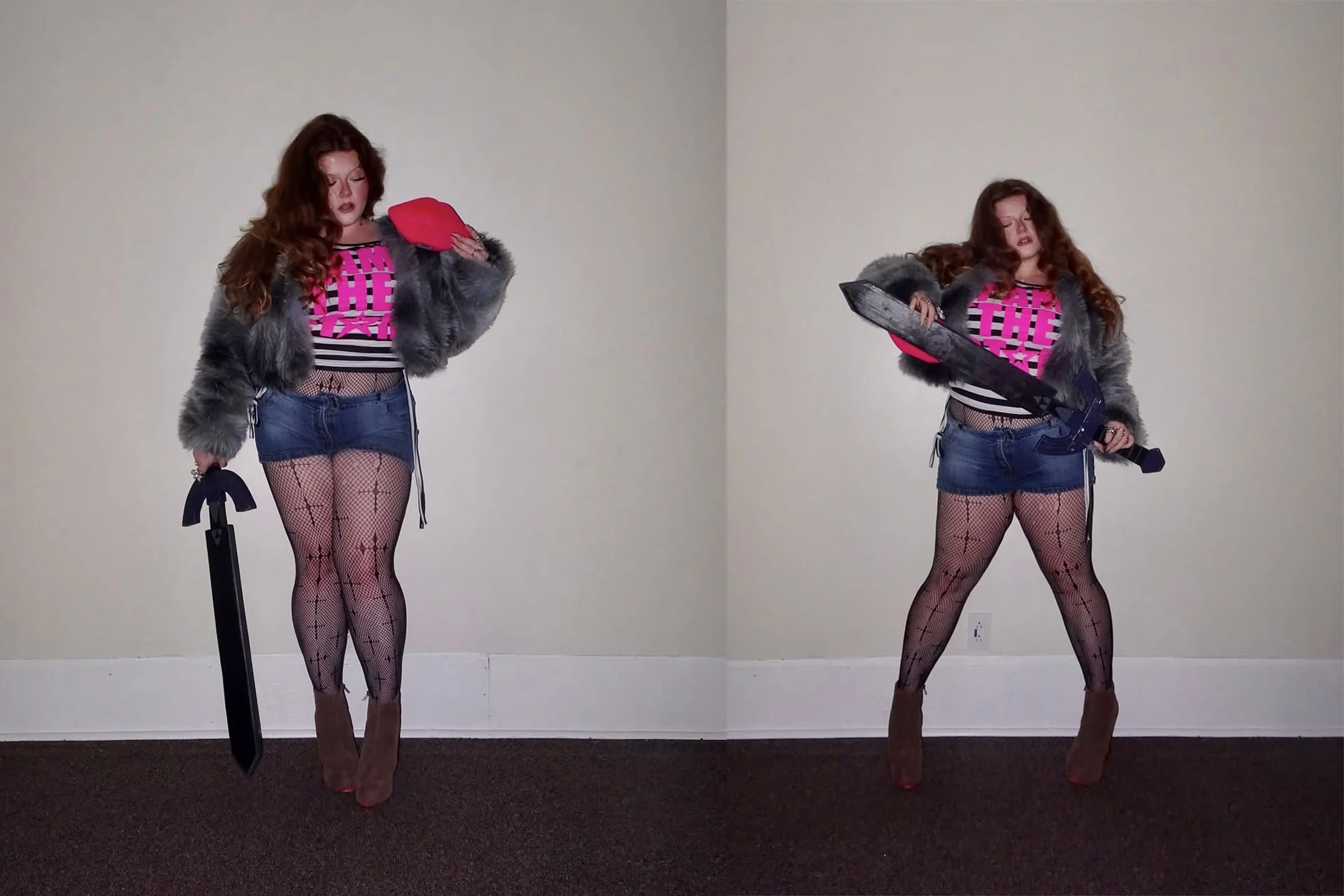
Rappers Sunshine Benzi in 2025. Image via Instagram.
"Bitches be stiffer than a dick pic / Like they came to bang, but bitches don't wanna get this / Let my balls hang, pop, ballers wanna pick this / They be on my wave, top, right there where the pick is, get, bitch…" Hmm. Good entendre but, unless the line has another unrelated meaning, how does a White woman from America's Midwest suburbia know this much about Black hair terminology?
Correction: this White woman is a Chicago native, and not from the monotonous Christian Midwest. That's according to a recent article from The Fader about TikTok's viral rap sensation Sunshine Benzi… whose management ignored our questions aiming to clarify her Chicago upbringing.
Sunshine Benzi's online success is niche enough that if your rap consumption isn't overwhelmingly women, and you're not queer, there's a chance that she hasn't made it to your For You feed yet. Her virality comes from her song "TRUMP THE BILL", which has garnered over 35,000 posts on TikTok. The clap-heavy track was produced by Rich Mello, who, over the past year, has mostly uploaded "Nicki Minaj type beat(s)" to his YouTube channel.
Close your eyes while listening to "TRUMP THE BILL" and it sounds comparable to what ChatGPT would spit out if your prompt was something like, "Make a Nicki Minaj song in this voice." With homage thematically a standard in rap music, the lines between reference and plagiarism can get blurry. But when the originator is Black and the emulator is White, the ambiguity fades.
"To this day, there's nothing like New York rap, especially drill. These artists are coming from such big places, focusing on their talent and honing their craft. And it's so raw. I've never been to a realer place than New York," Sunshine Benzi told The Fader.
Not even Chicago? The stomping ground of Sunshine Benzi, who draws no influence from the city in this statement and her music. Ironic, considering drill—a subgenre of rap music—was born in Chicago in the 2010s. It's a collection of sentences that Chicago rappers such as Noname, Chance the Rapper, Lupe Fiasco or Vic Mensa are unlikely to utter, but who knows? Consequently, this points to the most evident problem in Sunshine Benzi's schtick: inauthenticity.
The femme rap space, including music executives and fans, is obsessed with finding the new Nicki Minaj. They look for her mannerisms, cadence, and wordplay in every new rap darling who has the potential to make it mainstream. Blasphemy if you forget to mention her as an influence in your first ill-prepared press interview.
This search has reached another tipping point as Minaj descends into Trump's far-right orbit. Alarming political ties that Sunshine Benzi hasn't mentioned in her heaping praise of the rap queen. But she does mention that Trump should "sit down somewhere!" in a superficial Q/A with Interview Magazine.
When female rappers debut and you can spot the Nicki Minaj influence, it's not always cause for dismissal. Rappers tend to sound a fair bit like their idols early on, and coupled with Gen Z's fixation on nostalgia, things get murky. Doechii, after her historical win at the 67th Annual Grammy Awards, released the victory track "Nosebleeds", which at certain points sounds like "old Nicki". Everything can and will be utilised as a reference, but the thing with Sunshine Benzi is that her artistry starts and ends with Nicki Minaj, with nothing in between.
"Copying is taking the whole song or verse. People say I'm copying Nicki, and she had a huge effect on me, so of course I have some of her movement." Movement is an understatement. Even other New York rappers that Sunshine Benzi gives nods to—like Foxy Brown, The Notorious B.I.G. and Ms. Lauryn Hill—are also pivotal influences that Minaj herself has directly cited.
In a clip circulated on X by one of the many rap accounts on the platform, Sunshine Benzi combined verses from different Nicki Minaj songs into one track at a NYC show. Sorry, that is not homage; that's some fugazi shit.
“Where is the evidence that White rappers are having such a hard time in hip-hop culture?”
"People calling me an art stealer hurts. It's already vulnerable sharing my art. Especially being White in a rap space, I have to earn everything, and I'm going to." Sunshine Benzi continued with The Fader.
It has never been hard for White rappers in hip-hop, and they have never had to earn anything. This defence that Sunshine Benzi asserts in response to some hip-hop heads rationally questioning her place in the culture is a misleading narrative pushed by White rappers all the time during their come-up.
They're seeking some immunity for doing the unbelievably hard task of existing as a White person in Black culture, despite global hegemony contorting itself to uphold their White identity. In one of the few spaces explicitly meant for Black people, we're told that their perceived struggle to fit in and gain respect should be applauded. When Black people are in the same predicament, our contribution to White spaces must be of the highest quality, and it will still be overlooked.
Where is the evidence that White rappers are having such a hard time in hip-hop culture? Eminem is the best-selling rapper of all time based on album sales, as reported by The Recording Industry Association of America (RIAA).
Lil Dicky was able to pitch to the TV channel, FX, about this exact White rapper complex that turned into a successful comedy series. Jack Harlow, after his breakout year, was touted as Drake's successor. A pretty big fucking deal (despite Drake's soured reputation post-2024).
In 2022, BET denied Lil Nas X any nominations at their awards show despite his debut album, Montero, triumphing in 2021. Lil Nas X accused the move of being punishment for his very gay performance at their awards ceremony the previous year. However, Jack Harlow was nominated for a BET Award and performed in 2022. Then there was Post Malone, who used his initial rap career to transition into a rock star, country star, pop star, or whatever he's doing lately.
Sunshine Benzi has explicitly been rewarded because of her Whiteness. The Fader labelling her a "student of rap" when she only has three mediocre rap songs is a solid example of that, and her larger physique not deterring her success is another one. How many fat Black women have reached commercial rap success in hip-hop's 50 years?
There was Missy Elliott, Queen Latifah, and Lizzo is technically here when she's rapping. Chika and CupcakKe are too niche. Maiya the Don—despite having a viral TikTok song like Sunshine Benzi's "TRUMP THE BILL"—has seen her initial burst kinda fizzle... and is currently on a weight loss journey. Again proving how Whiteness, particularly White bodies, supersedes everything else.
Let's take time to reflect on the toxic cycle of wanting constructive change for the preservation of hip-hop but never taking action to do so. Despite plain foreshadowing of where this Sunshine Benzi story will end, hip-hop is still enthusiastically cheering her on. From her Black manager to her Black collaborators, she's a manifestation of the culture's self-destructive tendencies.