

Revisiting Tricky's 'Maxinquaye': The Sound of Resistance
Emerging from Bristol's fractured sound system culture, prolific producer Tricky reshaped British electronic music into something new. In a current music culture shaped by algorithms and nostalgia-for-sale, the defiant resistance of Tricky's 1995 debut solo LP inspires us to reflect on what we've lost along the way.
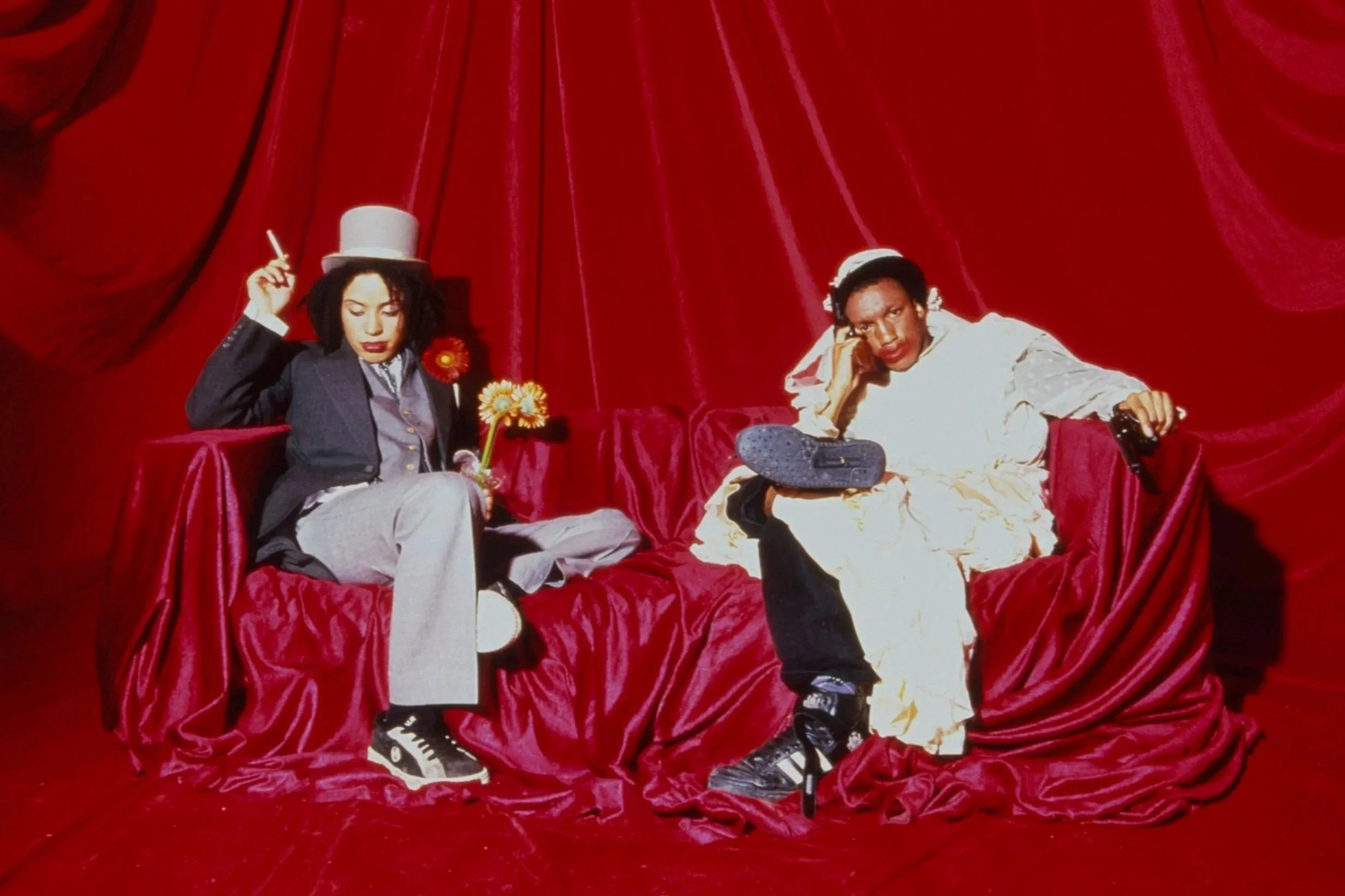
Martina Topley-Bird (left) and Tricky (right) in 1995. Image property of 4th & Broadway and Island Records.
Tricky is a funny artist when you really think about it. A pioneer of a genre he didn't even claim (more on that later), he's the living embodiment of 'never let them know your next move'. In late 2025, he became the face of the collaboration between Acne Studios and Kappa. Outside of fashion, he's appeared on platforms like NTS Radio to share a set or two. However, more often than not, he is the type of artist who shows little interest in the celebrity limelight.
He's worked with everyone from Björk and Cypress Hill's DJ Muggs to Grace Jones and everyone in between. When it comes to the small and silver screens, he's made blink-and-you'll-miss-it cameos in films like The Fifth Element and UPN's Girlfriends sitcom as well. Curious where it all started? The catalyst for his illustrious career lives inside his debut album, Maxinquaye. But before we get there, let's go back to the beginning.
Adrian "Tricky" Thaws was born in 1968 and grew up in Knowle West on the southern outskirts of Bristol. His father, Roy Thaws, ran the Studio 17 "Tarzan the High Priest" soundsystem back in the '60s with his brother Rupert and his own father Hector, forming a familial musical collaboration early in Tricky's life. Alongside his late mother, Maxine Quaye, to whom his acclaimed album is attributed, both factors had an impact on Tricky's childhood, which was later woven into his work.
Meanwhile, Bristol was becoming subject to riots and regeneration schemes by the last vestiges of post-war labour. Thatcher-era optimism pushed office work as industry hollowed out in the 1980s. The city was moulded by its emergent middle class, West Country agriculture, its slave-owning history, and Windrush migration.
The interaction of these demographics—the movement and fracture between town, gown, soundbwoy and punk—formed Bristol's underground ecosystem. Its seduction has become neatly packaged as a form of cultural currency that attracts an influx of new-gens seeking an authentic Bristol experience.
The Bristol soundsystem scene began with the formation of The Wild Bunch (a creative collective of artists tied to Swedish singer Neneh Cherry), who hosted parties in the St. Paul's area. This group included Robert Del Naja, Grant Marshall and Andrew Vowles, also known as Massive Attack. Tricky emerged as a key figure in the trip-hop genre, despite spending much of his career rejecting that label. His music helped define a version of electronic music and hip-hop that slowed down and became more introspective, blending digital innovation with themes of social dissent.
The parties thrown by the St. Paul's residents fused reggae, dub, hip-hop and funk, later becoming the mechanics of the trip-hop genre that producer Jon King once described as "that late, late, late night vibe, where people were just allowed to just go on and on and on. And the bassline just rolls and rolls."
Bristol was uniquely positioned to synergise those textures and transmute them into sound. This moment permeates into the trip-hop mood; commanding influences from seemingly opposite ends of the musical spectrum. Post-industrial disillusionment met with global sound. The music became a vessel for dissent, because to Tricky "that's what makes good music."
“The way Tricky works—fucking around with sounds on the sampler until his sources are unrecognisable, wraiths and ghosts of their former selves; composing music and lyrics spontaneously in the studio; mixing tracks live as they’re recorded; embracing the glitches, inspired errors, hiss and crackle—it’s strikingly reminiscent of early ‘70s dubmeisters like King Tubby.”
Tricky, the rhymer of the group, left Massive Attack after their second album, 1994's Protection, which had pushed the genre in a divergent direction. His debut 1995 LP, Maxinquaye, dedicated to his late mother, arrived in a pop landscape saturated with easy listening. His own words—"MTV moves too fast"—signalled an abrasive yet intimate dissonance with how television and magazines misrepresented reality, and how "they're not how people live their life."
Martina Topley-Bird, the album's co-pilot and lead vocalist, brings a soulful, R&B-tinged presence that threads through its dub, experimental and electronic textures, grounding Tricky's jagged, risk-taking production with intimacy and warmth. Tricky met her when she was a teenager, and her voice became the album's emotional anchor.
Working alongside them, pop and rock producer Mark Saunders, known for his work with The Cure, applied his pop-leaning ear to add polish and accessibility, providing a subtle counterbalance to Tricky's serrated artistic edges and helping shape a record that is both daring and listenable.
The free-form, single-take recording sessions imbue the Maxinquaye soundscape with hesitations encoded via the Akai S1000 sampler. This noise is centripetal, in the terms of cultural theorist Erik Davis, a "distorted channel, interference, echo, superimposition."
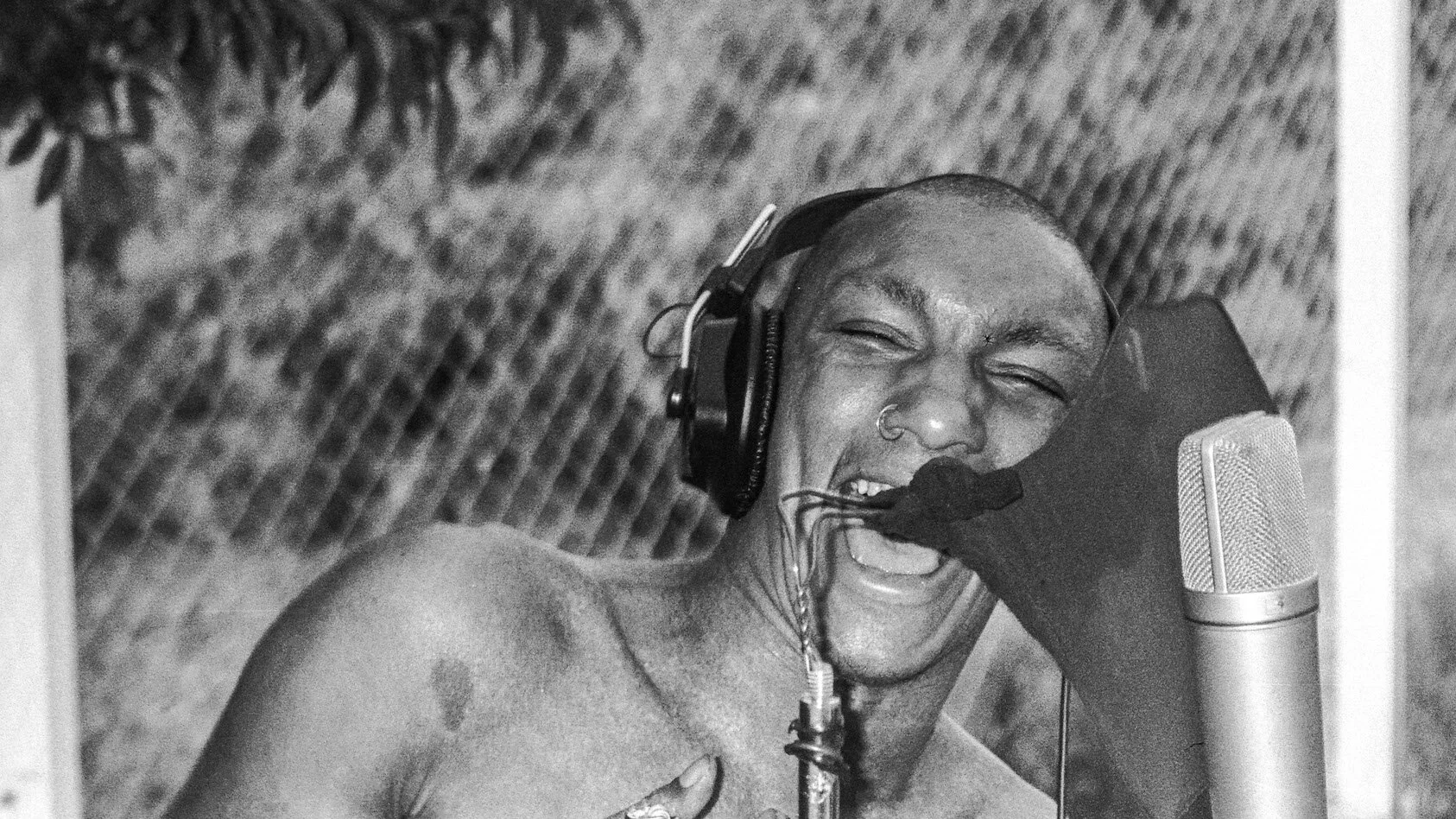
Tricky in 1994. Image property of Mark Saunders.
The album's refusal to simplify itself for easier consumption feels increasingly radical in today's music culture, which is driven by algorithms for market efficiency. Digital media can no longer be considered a neutral tool—algorithms influence our listening habits while platforms manipulate our attention spans. Music often becomes mere background noise. This creates a paradox of cultural stagnation, where everything is instantly accessible, yet nothing truly resonates.
Tricky's distaste for genre-binding resists the categorisation necessitated by AI-curated playlists. Weird time signatures, downtempos offset by delayed beats, and opaque lyrics prevent easy consumption. Maxinquaye cannot circulate easily within the logic of these market requisites, because it is too unresolved to be content.
Social media encourages us to consume quickly and to feel briefly. Doomscrolling and content saturation have enabled banality to dominate our feeds; we slap "subversive" on anything, even as it satisfies the same impulse of media consumption.
It feels like subversion no longer resides in provocation or novelty. Albums like Maxinquaye, which deny the instant dopamine of consumption, suggest that subversion actually lies in the ability to exist outside the mainstream—to sit in uncertainty rather than assert a narrative, message or truism.
"Beware of our appetite"—on his track "Aftermath", Tricky warns us of this: our desire to consume nostalgia and authenticity as we would fast food. The ease of gentrification in cities like Bristol has only enabled this further. As digital media becomes more sophisticated and our lives more convenient, our sounds have grown cleaner and safer.
Maxinquaye exists elsewhere—at the threshold between the subconscious and technological meditation, with error and interference coded into itself. Erik Davis notes what's lost when the threshold disappears: "Listening to a CD just ain't the same as rewinding a freshly made magnetic tape… we as listeners don't hear anomalous intrusions—we just hear voices." As the machine smoothes the experience of its irregularities, Tricky reintroduces them through noise.
Ian Penman, in his article Black Secret Tricknology (The Wire, 1995), observes that we should aim to reclaim what is truly human—such as memory, lack, doubt and danger—through technology, especially when it risks fading away in the confusing haze of modern marketing.
His recent resurgence, through new releases and an upcoming tour in May this year, offers us a significant cultural question. Who is listening now? Is it those who remember Maxinquaye as the soundtrack to their own disorientation in the '90s, where Tricky provides continuity rather than nostalgia? Or is it the new generation, raised on streaming abundance, seeking Tricky less through memory than for an absent true "Bristol experience"?
What is so easily branded as nostalgia is often something else—usually curiosity or desire for texture in an increasingly homogenised soundscape. Tricky does not perform nostalgia, nor does his work seek to recreate or polish the past for modern hyper-consumption. Instead, it remains resistant or even hostile to this comfort. The lineage sustains itself because the music was never really of its time to begin with. It's not revivalism or brand-new retro because it has always existed outside mainstream temporality.
What Tricky offered in Maxinquaye was friction and delay to our surrounding systems. As the real world slips further into digital ether, we risk forgetting how to feel without guidance. With no resolution or manifesto, we are reminded that some emotions are inexplicable, that meaning cannot be neatly packaged and sold to us.
Tricky's comeback provokes us to challenge how we think about cultural progress. Gentrification makes living more convenient: we can consume culture while its meaning erodes. Meanwhile, technology increasingly mediates our emotional lives. Perhaps we should ask whether our sounds are changing accordingly. In a landscape of hyper-consumption, are we losing patience for ambiguity, for slow listening, for experiences that cannot be optimised?
Stream Maxinquaye below: