

Afroswing Raised a Generation... What Happened?
A heartfelt tribute to the golden age of Afroswing. Leave your BBM PINs at the door...
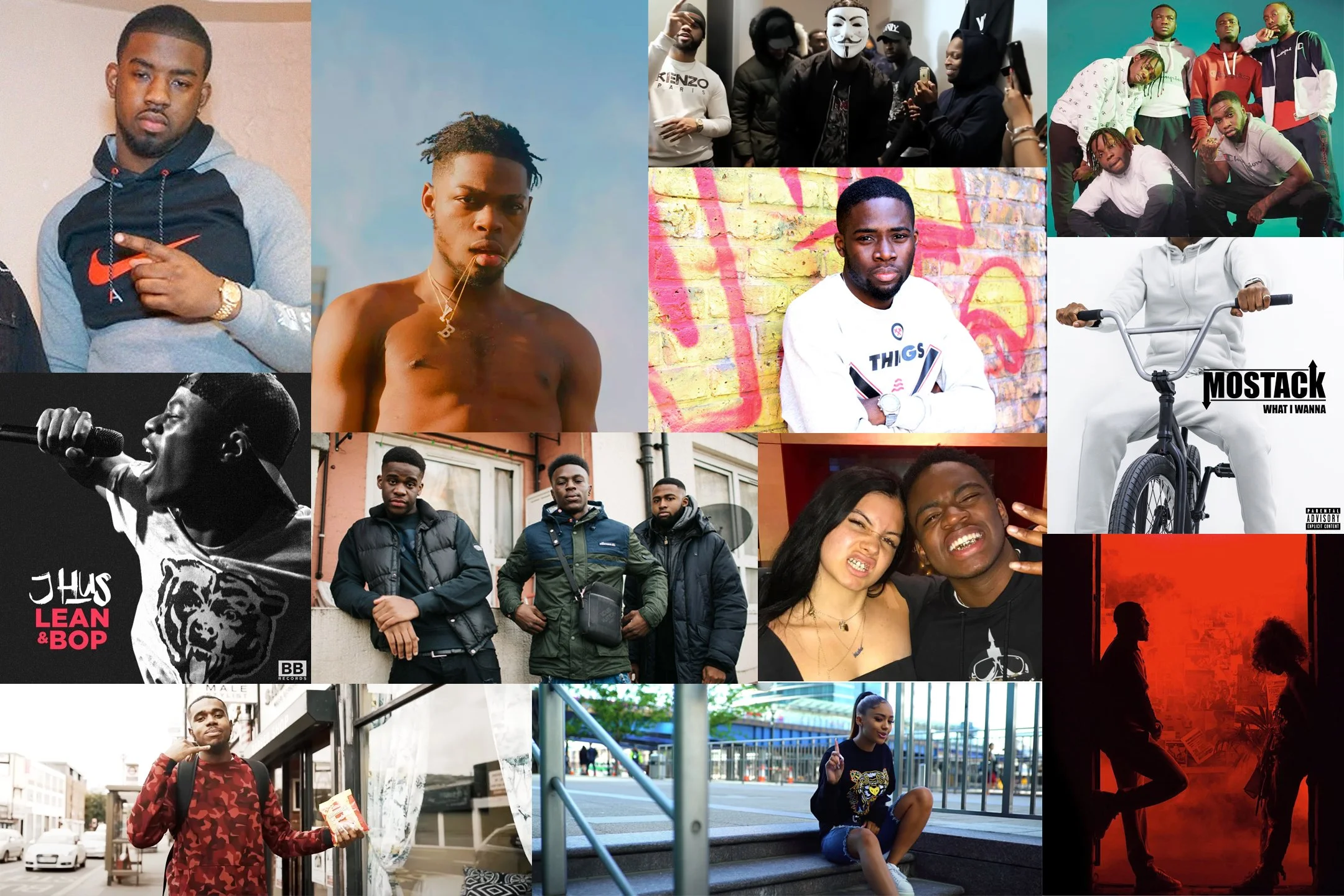
Collage property of The Culture Crypt.
It's summer 2017. The sun is setting and I'm 14 years old, walking home from evening mass, humming a tune that, for many of us, would become a generational anthem.
Although I was touched by the gospel of the day, I was even more moved by the opening piano chords of Lotto Boyzz's "No Don", as the lyrics followed: "Everybody wants to swing my way, because they heard I got a banger." Hands tucked into my navy bomber jacket from New Look (yikes), I smiled to myself—a core memory in the making.
For many of us who came of age in cities across the UK, the Afroswing era (from the mid-2010s to just before the pandemic) was more than just a musical wave: it was a cultural blueprint.
Artists like J Hus, Not3s, Tion Wayne (during his singing days), Belly Squad and others provided a sound that felt both familiar and foreign at the same time. Afroswing was more than cool: it was a badge of identity. It was indeed a form of cultural capital across British schools.
Me at 14.
The term Afroswing, coined by Kojo Funds, captures the fusion of West African rhythms woven into the genre's production (marked by distinctive African percussion) alongside elements of dancehall, UK dance music and American trap.
This hybridisation is also reflected in the creolisation of the lyrics, as the children of the diaspora incorporate both their 'mother's tongue' and Multicultural London English (MLE). For instance, in ZieZie's song "Fine Girl", he plays with Lingala, stating: "I'm a dark-skinned dude from the Congo. Na lobaka Lingala soki o yoki te."
Black British cultural production, or what is commonly understood as 'Black' in Britain, was historically centred on dominant narratives of Caribbean identity. This is perhaps unsurprising, given how mainstream media has long contributed to the construction of a monolithic Black identity, often reducing Black Britishness to Windrush-era migration or the legacy of transatlantic slavery.
However, Black Africans make up a significant portion of the UK's Black population. Yet, their presence is often sidelined or reduced to narrow representations typically limited to Nigerian, Ghanaian, or Somali identities.
Unfortunately, being 'African' in the UK during this era was not palatable, cool, or, to put it crudely 'rated'. Think of earlier KSI videos, viral pranking African parent videos or jokes about eating fufu or jollof rice.
Afroswing helped shift that narrative. It validated African heritage in a way that was stylish, sonic, and celebratory. The genre welcomed South Asians (such as Koomz), Caribbean artists (MoStack), and other influences (Geko and B Young), showcasing a sound that reflected London's multicultural nature.
The genre was less about hierarchy and more about hybridity. Furthermore, this era coincided with a time when the Conservative government was not only debating leaving the EU (which was finalised in 2020) but also enforcing austerity, leading to the growing decline of public-funded services, such as youth centres, schools and art programs.
While the election of Sadiq Khan as London's first Muslim mayor in 2016 signalled progress in political representation, nonetheless, genres like Afroswing provided a more authentic form of self-definition for many Black and diasporic youth outside the confines of formal politics.
The music industry is an intensely exclusive space, which is gendered, racialised and classist. Despite mainstream music industries profiting from the 'cleanliness' of Black cultural production, these industries continue to gatekeep and poorly market Black individuals as well as other racialised marginalised groups.
Therefore, the significance of DIY studios, informal technological knowledge of machines, and having someone with an HD video camera sustained through local networks, i.e. 'the mandem', creates an alternative, culture-driven mirroring of the industry. Whether it be in a friend's bedroom or inside school classrooms, young artists were finding ways to produce music with or without the help of the music industry.
This is not a new phenomenon: members of the Black diaspora have long created alternative routes for disseminating culture to one another. If we look at the reggae soundsystem culture in 1980s Britain, where young Caribbean men created make-shift sound systems and used unconventional 'partying' spaces, e.g. the basement of a church or warehouses, to the birth of pirate radio in the 90s and grime contained in council estates from the early 2000s.
Essentially, these unconventional spaces became symbolic sites where marginalised individuals could create art and sustain culture. Black cultural production in Britain has often emerged from exclusion, shut out by major institutions and corporations unwilling to 'blacken' their spaces.
I remember watching the "Mujo" video on PacmanTV and thinking, 'I could totally shoot this.' So, I present to you my quick guide to your very own 2010s video shoot:
Lights, Ciroc, Action: The 2010s Music Video Starter Pack
1. SOURCE THE LOCATION. IT CAN BE YOUR FRIEND'S HOUSE, YOUR OWN, OR YOU COULD RENT A PLACE.
2. BRING THE BOYS: THE MORE THE MERRIER!
3. OBVIOUSLY, YOU HAVE TO BE DRIPPED OUT. CANADA GOOSE JACKET, STONE ISLAND JUMPER OR KENZO JUMPER, BURBERRY SHIRT, SKINNY JEANS WITH PAINT DRIPS, GIUSEPPE'S. AIR FORCES CAN WORK.
4. BRING SOME LENG ONES, BROWN-SKINNED OR DARK-SKINNED WOMEN, OF COURSE.
5. GRAB THAT 'ONE' VIDEO VIXEN. BTW, SHE's WAY OUT OF YOUR LEAGUE.
6. PREFERABLY FILMED DURING NIGHT-TIME. JUST SO IT LOOKS LIKE YOU'RE HAVING A REAL PARTY… IT'S PROBABLY BEST TO HOST A PARTY!
7. LAST BUT NOT LEAST, BRING A BOTTLE. AN EMPTY RED CUP WILL DO.
This resistance is rooted in a long-standing fear that associating with working-class and racially marginalised communities would evoke historical stereotypes of Blackness tied to violence, poverty, and criminality, thereby 'tainting' those spaces. It sounds funny now, but this formula was the look of an era. Accessible, yet coded in aspirational aesthetics.
Where were the women?
The Afroswing era was very gendered. To name a few female artists of the time, Stefflon Don, Darkoo, Raye, Mabel, Paigey Cakey or M.O (the girl band) and Amelia Monet. Or even the female vocalists who often go unnamed, e.g. the vocalist in the chorus from the song "Torn" by 23. There was an overwhelming presence of men.
A memory of that decade, which should not be forgotten nor neglected, was colourism and the vulgar over-sexualisation of Black women's bodies. The hyper-sexualised fantasies of Black women are contingent on American hip-hop and thus are not a surprising trope. Although the discourse on colourism has been lacking recently, during the Afroswing era, colourism was a significant issue: artists often expressed preferences for light-skinned women, often denigrating—directly or indirectly—their dark-skinned counterparts.
However rare, there were moments when darker-skinned women appeared as central love interests or leads. While these exceptions are notable, they should not overshadow the broader pattern of exclusion and fetishisation.
bell hooks argued that the commodification of Black women's bodies is inherently political, and Afroswing was no exception, particularly because colourism played a significant role in promoting some women's success over others. Equally, we must remember the discourse surrounding dark-skin versus light-skin that prevailed on Twitter, often fueled by the misogynistic sexual fantasies of some Black men.
Despite the genre's frequent lyrical themes of love and courting, it often failed to engage with Black women as subjects rather than objects. Emotional resonance did exist.
I remember feeling deeply moved by Vianni's song "Recognise", but the ethical politics of representation did not always align with that emotion. The tension between effect and erasure is one of the most complex legacies of the Afroswing era.
The discourse on colourism has fallen short in recent years. During the Afroswing era, colourism was a major issue: artists often sang about their preference for light-skinned women and consistently featured them as video vixens.
The Future of Afroswing
Afroswing was destined for a crossroads. Unlike jazz or soul, its popularity didn't mean complete absorption into the mainstream (even though many of the prominent artists ended up on the UK top charts). Instead, by 2019, Afroswing was overshadowed by the rise of UK drill and the resurgence of American trap influences.
Songs like OFB's "Ambush", Pop Smoke's "Welcome to the Party", and DBE's melodic trap marked a shift in the soundscape. But something else changed, too: the cultural mood. In the last five years, there has been a cultural shift towards valorising your ethnic heritage. What I mean by this is that there is pride in knowing your connections to the diaspora.
The proliferation of young Black women wearing braids locs, and natural hairstyles while also intentionally making their holiday destinations places like Jamaica, Nigeria, Tanzania, etc. Especially for those from the African diaspora today, there seems to be pride in claiming to be African, the ultimate valorisation of being African.
Thus, the rise of Afroswing was accompanied by increased acknowledgement and promotion of music originating from the continent, with artists such as Tyla, Tems, Ayra Starr, Shallipopi, Fally Ipupa and Rema dominating the top charts. In its fall, Afroswing made space for something new, something more globalised.
Afroswing was a moment born from the diaspora, joy, hustle, and heartache. It carried contradictions: inclusive yet patriarchal, celebratory yet colourist, DIY yet aspirational. Like all cultural waves, it left behind a complicated legacy.
But for a generation of kids walking home in their bomber jackets, eating 20p Freddos, wearing Adidas all-stars, attending AP parties and using the Snapchat dog filter—this was a time I tend to reminisce a lot about. It was everything. And we remember it that way, banger after banger...
Stream Common Sense by J Hus below: