

What is Wrong with Young Thug?
Seriously.
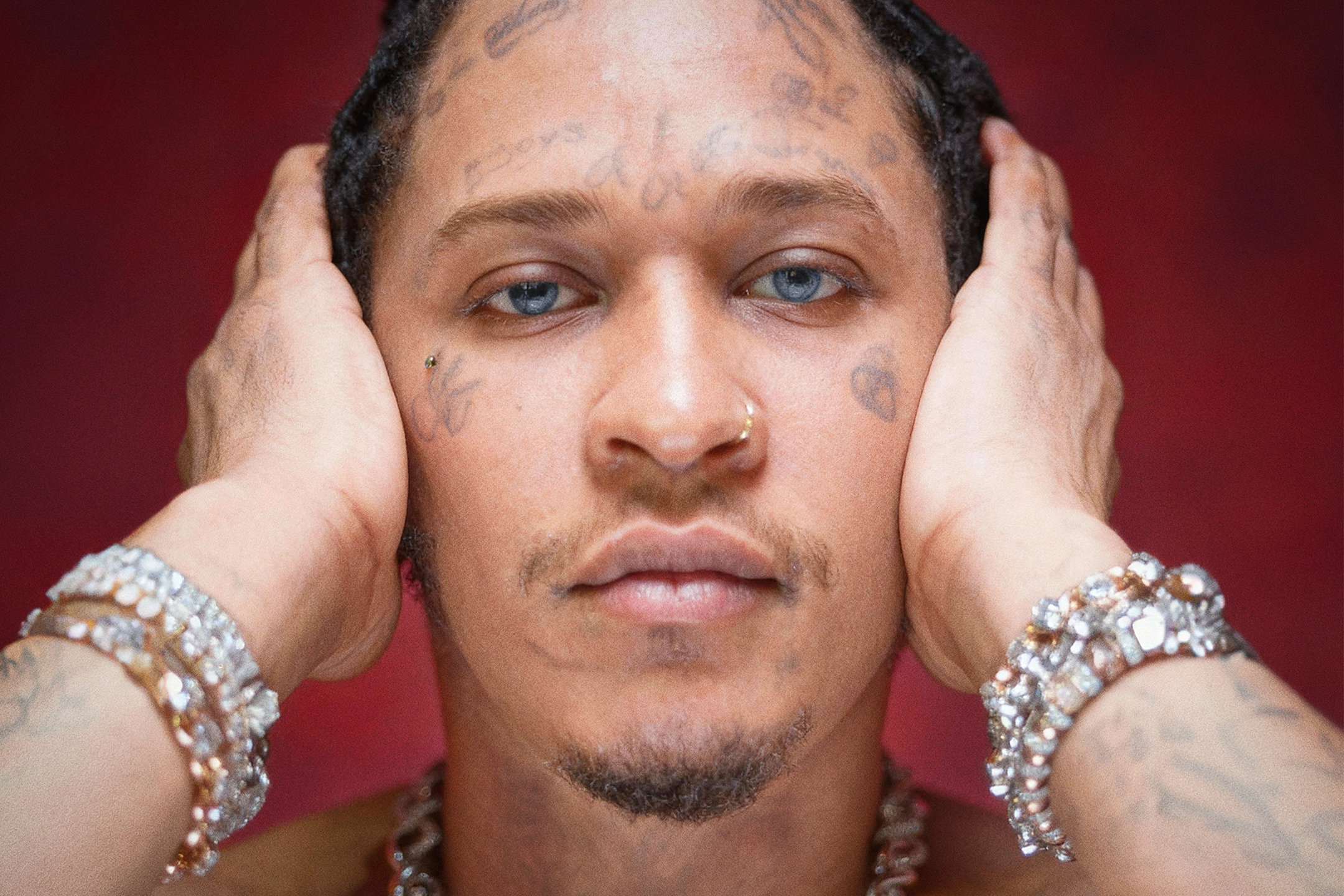
Artwork for UY SCUTI. Image property of YSL, 300 and Atlantic Records.
A couple of months ago, I received a message from a friend that's been stuck in the back of my mind since: what is wrong with Young Thug?
For the uninitiated, that message referred to the Atlanta rapper's most recent album, UY SCUTI, and more specifically the album's cover—a headshot of Thug with pale, ivory skin, covering his ears in the "hear no evil" pose while looking as if he's fallen into a massive vat of Caro White.
On Instagram, the cover is captioned "IF YOU WANNA BE THE BIGGEST … GO WHITE." That post was accompanied by another in which a slew of Thug's colleagues—Lil Baby, Cardi B, Sexyy Red, 21 Savage—were all endowed with that same bleached hue. "My new friends," the caption read. The very first song on the album, "Ninja", has Thug saying 'nigger' with a hard R around 56 times.
On the surface, this can be taken as a poor attempt at trolling or satirising Whiteness, à la White Chicks or Druski's recent whiteface (white body?) NASCAR skit. But even as Thug stumbles his way through explaining his rationale, it's clear that the whiteface is a bit more deliberate than purely trolling.
"I think it was just some funny shit, but it's still serious to the point like, I went wit it … we always joked and played in my hood like, you wanna be the biggest? Go White," Thug said in September on the Its Up There Podcast. "It's just a narrative that the world paint, and we just going with the narrative… I wanna be the biggest in the world. How can I be the biggest? The very first answer to that question from anybody should be 'you gotta be White.' You know, they always let the White people be the biggest. I love White people too, but they always let the White people be the biggest."
Instead of expanding on that in any way, Thug pivots to the "I'm just trolling though" in an attempt to absolve himself from the more serious conversation his prior statement begets. "It's just all fun though, I'm not with none of the politics, I ain't with none of that political shit. We having fun, it's music, and you shouldn't take it so seriously. It's not like we can make it out alive anyway. We all gon' die no matter what. So it’s just like you gotta choose to be happy and put in the world what you want to put in the world."
Thug offered a similar spin while livestreaming with far-right edgelord content creator Adin Ross.
"Would you ever do that? Wanna be White?" Ross asked.
"Yeah," Thug replied. "Prolly a day tho."
There are a couple of ways to look at this. On one hand, it feels impossible to have the conversation about what exactly is wrong with Mr. Thug without acknowledging his turbulent experience with the legal system.
Thug spent more than two years locked up in Fulton County Jail after he and 27 others were hit with a 56-count RICO charge—a move historically reserved for mafia-style crimes, but that has recently been levied against President Donald Trump (rightfully so in my opinion), left-wing anti-Cop City protestors in Atlanta (unfairly in my opinion), and Thug—who had some of his lyrics used against him in court in the process.
It's clear from interviews and countless leaked phone calls that Thug's time in prison was extremely difficult. He famously dissed Gunna, called out Kendrick Lamar for not giving him a feature, called GloRilla ugly and said he would "never pursue her, ever" (he's supposed to be in a relationship Mariah the Scientist, mind you), and even dissed Atlanta legend André 3000, saying he "ain't put nobody on." But where would Young Thug or the entire Atlanta scene be without Outkast?
For what it's worth, Thug said he apologised and attempted to explain himself after the fact. "I think I was just so fucked up, and I just felt like it was just over. Like I'm just sittin' in jail, 24 hours … I'm in the cell 23 hours," Thug said in a later interview. "At this point, I'm just like 'man, I don't give a fuck.' Life ain't what I'm thinkin' it is…at this point I'm just talkin'.
He offered GQ a similar perspective. "I was actually in court. I was on trial. And I just started looking around the courtroom like, Damn, there's a lot of people in here. It's cameras. It's the longest trial in Georgia history … And then me just sitting in the cell every night alone, it was just kind of like, 'I'm big.'"
"I think I'm too big for jail. But I think I'm not too big for God, so God could put the biggest person in there," he continued. "I feel like I'm taller than the jail, but he somehow could just squish me in there."
It's evident that Thug is bitter about his time in jail, about being ripped from the life of luxury and indulgence that he usually raps about. The intro to the first song is over a minute of court tape of a prosecutor telling a judge how evil and dangerous he was.
And on some level, this sounds like a famous Black man realising he's still a Black man, yet being hopelessly unequipped with the range to actually process that in a way that isn't just making yourself white on the cover of your first album after almost three years in jail.
I am sympathetic to Thug's trial, which was extremely targeted and presumptuous, as is the nature of the RICO charge. And I do appreciate him nudging at the periphery of the conversation around Blackness, consumption, and the carceral state. But doing so without going even just slightly below the surface only makes this narrative, and the album in general, fodder and content for white teenagers on social media.
Ultimately, the question of what is wrong with Young Thug is much larger than just the album cover or Young Thug himself. It's yet another example of the level of unseriousness and carelessness that many Black artists—many of whom (rightfully) claim to be the primary arbiters of Black culture—hold towards their own creative legacy.
Making your skin white and saying "they let white people be the biggest" is neither subversive nor smart because the conversation stops there. And honestly, the album was way too boring, way too milquetoast to justify that album cover in the first place.
“Making your skin White and saying ‘they let white people be the biggest’ is neither subversive nor smart because the conversation stops there.”
Furthermore, it has become glaringly apparent over at least the past decade that being an arbiter of Black art and culture does not automatically make you a good steward of Black art and culture, which is frustrating to me, because they have such a rich past and present of good stewardship to pull from.
From Monaleo's "Sexy Soulaan" to the discographies of Noname, Earl Sweatshirt, André 3000 and more, there is a wealth of Black artists who are thoughtful and deliberate about what their culture means to them. D'Angelo, who we recently lost, was among the best and brightest of these stewards.
I'm aware that begging the Black diaspora and its messengers to take themselves more seriously may be a fruitless endeavour, given the multimillion-dollar corporate contracts the most popular of them have signed. But without some kind of recalibration, this kind of stream-centred minstrelsy will only erode the foundation that those who came before Thug and his ilk built.