

'Cause It's Fan-Tas-Tic: Revisiting Slum Village's Imperfect Masterpiece
Caught in a record-label tailspin, Motor City hip-hop trio Slum Village's original 1997 debut album circulated through leaks and word of mouth, becoming a cult classic long before its official release. Here's a look back at Fan-Tas-Tic, Vol. 1—the gem that almost never was.
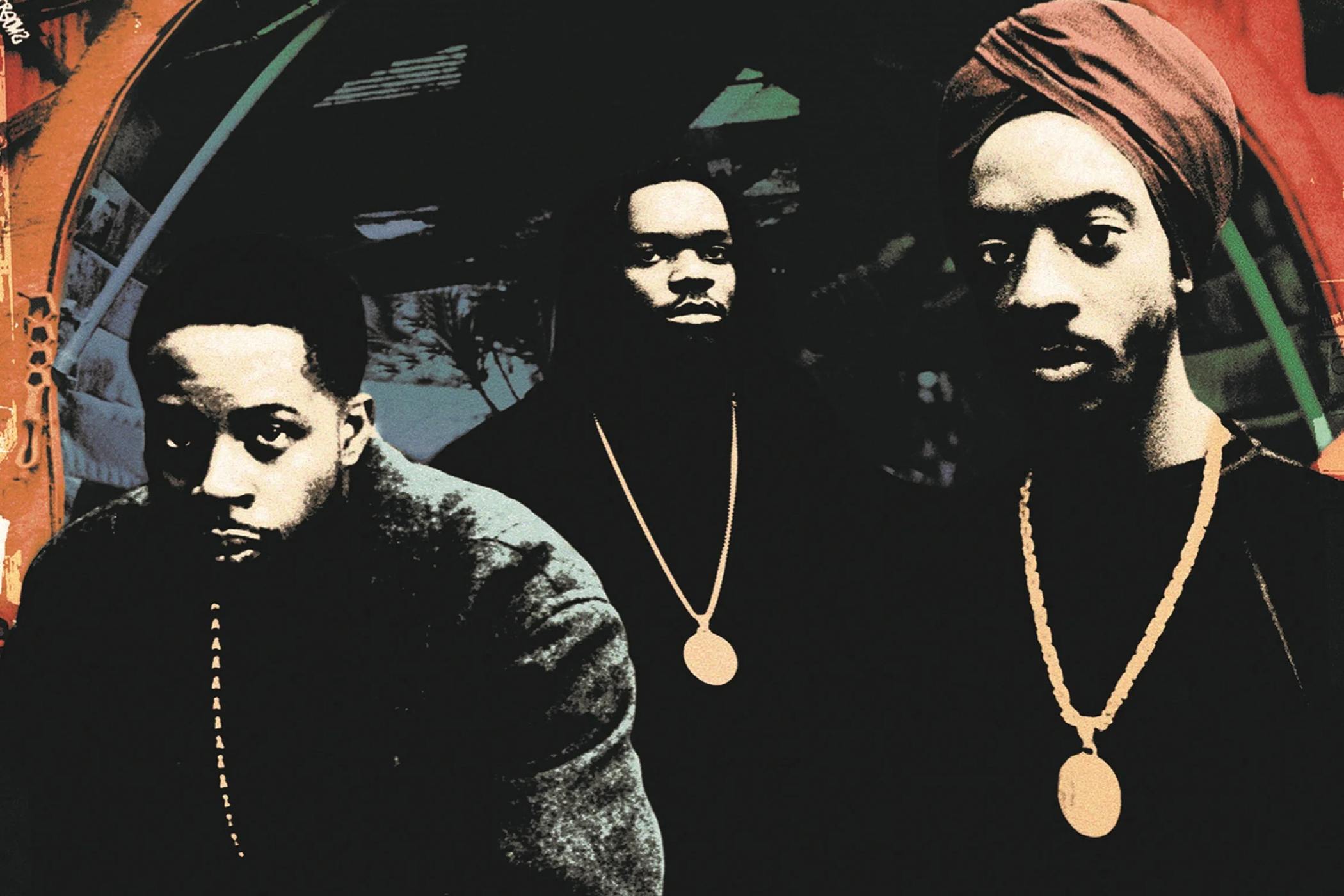
Artwork for the 2006 official release of Slum Village's 1997 debut album, Fan-Tas-Tic, Vol. 1. Image property of Donut Boy Recordings and Barak Records.
June 13, 2000. The day many across the world were introduced to Detroit group Slum Village by way of their debut album Fantastic, Vol. 2. Initially completed two years prior for a major label that became obsolete, the 71-minute excursion saw the spiritual gangsta of Titus "Baatin" Glover, the stuttering flow of R.L. "T3" Altman III, and the nonchalance of James "Jay Dee" Yancey unite around the latter member's innovative production style.
More than 25 years on, despite multiple line-up changes and significant deaths within the group, the album's legacy and impact is undeniable—especially in connection to Jay Dee, best known as J Dilla. But does Fan-Tas-Tic, Vol. 1 (aka Fantastic, Vol. 1), the 'album' that led the group to this point, deserve just as much love?
Well, let's rewind to the group's humble beginnings. Growing up around the Conant Gardens neighbourhood of Detroit, Baatin and T3 met Jay Dee through a connection with a fellow high school student, leading to a friendly rap battle between the teens. Heavily inspired by this, T3 would schedule a meeting to form a big collective called Ssenepod.
A name change ensued, reflecting the state of their neighbourhood, and then the eight members became three. They would exhaust a significant period of time liaising with record labels to no avail. On top of that, by the mid-'90s, Jay would start to get his name out there whilst working under the wing of legend Q-Tip and his newly-formed production team The Ummah.
At the time of Slum Village's formation in 1994, hip-hop was beginning to harness the global power it wields today. The year prior was a year of growing pains for hip-hop at large. Premiere hip-hop publication VIBE Magazine was officially launched in September of 1993, giving rap a slightly sleeker counterweight to The Source's 'boots-on-the-ground' reportage.
In 1994, West Coast rap had emerged as the dominant sound in hip-hop and the Wu-Tang Clan were the equivalent of a two-year-old toddler—yet to ignite their superstardom. Meanwhile, the Native Tongues collective was about to enter a kind of fragmented hiatus, following the late-1993 releases of De La Soul's Buhloone Mindstate and A Tribe Called Quest's Midnight Marauders. Nas' Illmatic wasn't Platinum-selling (just yet), and Jay-Z was still rapping fast like DC's The Flash.
Closer to Slum Village's production style, The Roots were putting the finishing touches on Do You Want More?!!!??!, ready to serve up album number two. Despite hip-hop's fragmented web of talent, one thing was clear: regionality or coast affiliation was no longer the only currency: the underground was becoming a breeding ground for distinct voices waiting to redefine what hip-hop could sound like.
For a good portion of 1996, Slum Village worked on their unofficial debut album Fan-Tas-Tic, Vol. 1. It's an album that, despite its imperfections, still somehow came out perfect. Released independently on cassette the following year, and sold primarily around the city of Detroit, the album is the result of suppressed tension between the group and experimental techniques that may pass the average listener by.
Imagine forming a group, making it a mission to get a record deal, and then your fellow member flourishing as a producer for other artists, going so far as to make time for another local group instead of your own. According to Dan Charnas' Dilla Time biography, that's exactly how T3 felt towards Jay Dee.
While not exactly entitled to Jay's success, the patience for a Slum Village album was growing thin. It wasn't until a meeting was called that the project was finally put into action... but under one condition: Baatin, T3 and Jay would all have to rap over nothing but a metronome.
Between hearing the album itself and the multiple interviews that have explored the early days of Slum Village, you could perhaps conclude that the metronome technique was not applied to every song on the album. Still, gems such as "The Look of Love" and "Players" are executed in a more fleshed-out manner—connecting perfectly with the instrumentals, whether through the specific sample used or the melody within.
In a 2023 Slum Village interview with the podcast Questlove Supreme, T3 would even admit that the recording process was all over the place: "We did it in a week because we had... all these songs just from the 10 years of being together." You can hear the rough mic quality in moments like "This Beat", which was primarily a musical argument between T3 and Jay, put together over a Keni Burke-sampled banger.
The album's name was a heavy delineation of the chemistry between Baatin, T3 and Jay Dee. Although the opening "Fantastic" interlude has Baatin as the very first voice you hear on the album, the rest of these interludes see the three chanting a particular refrain: "This that fan-ta-sarro, you say huh, what? You know."
There's the back-and-forth verses between the three on the short and sweet "I Don't Know" (later extended on the official Vol. 2 album), with a beat and cadence heavily backed by vocal samples from the legendary James Brown. The track is so seamless that it's hard to believe the vocals were done before the beat. "Estimate" sees the trio going back and forth to warn a guy they know not to put on an image to impress them or the women around him.
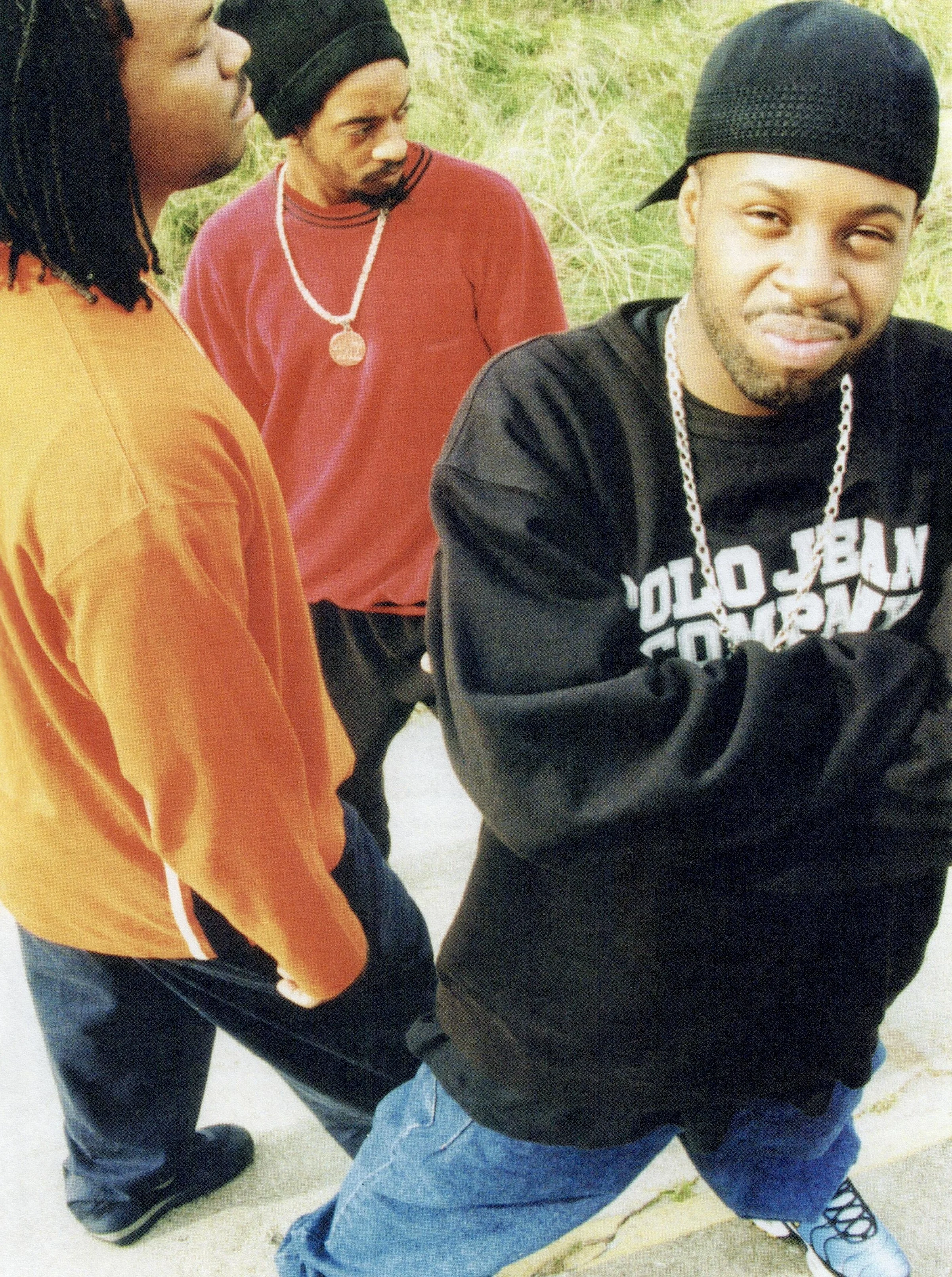
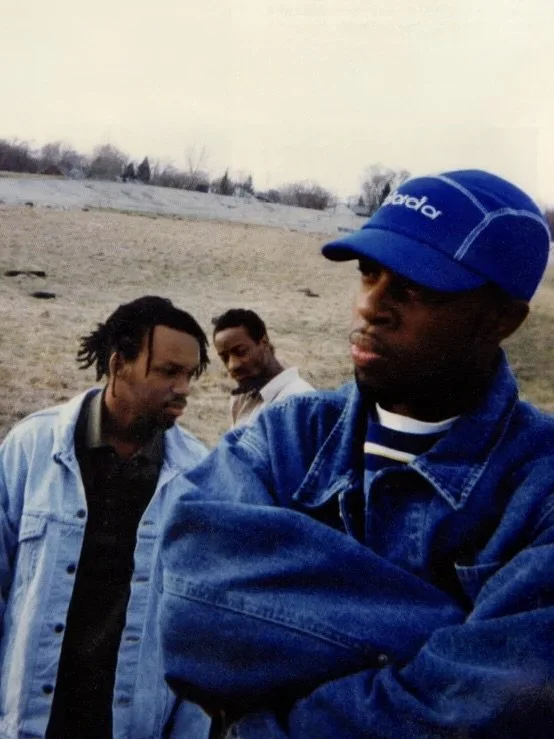
Slum Village in 1997. left to right: T3, Baatin and Jay Dee. The photo on the right was the original artwork for the album's cassette pressing. Images Property of Waajeed.Standout track "Players" houses an extremely intentional sample flip, manipulating the harmonious vocals of The Singers Unlimited's "Clair" as if it's saying the song's title, even ad-libbing specifically around it—the final result is a song specifically targeting a fellow Detroit group, 5 Elementz, as biters.
Even beyond the group's chemistry, collaboration is key throughout Fan-Tas-Tic, Vol. 1, so much so that the body of work only has two features, one of which is another local group. "Fat Cat Song" utilises a short yet effective guest verse from fellow Detroit rapper Phat Kat, fitting like a glove alongside Slum Village's synergy.
And how ironic that Slum Village dissed fellow local group 5 Elementz on "Players", just for them to end up on the album with the appropriately-titled "5 Ela", trading bars smoothly alongside Baatin, T3 and Jay over a groovy instrumental.
Equally, moments such as the respective "Pregnant" interludes from T3 and Baatin, as well as Jay Dee's funky "Give This Nigga" make enough room for the members to showcase their uniqueness on the mic. Here, they delve into their own experiences, whether it's haters bothering T3, Jay demanding respect, or Baatin attempting not to cause a scene at a potluck.
“The LP was instrumental in shaping the Soulquarians as we know them today.”
With a good portion of the album recorded on a metronome track, the album has plenty of room for experimentation, so it's no surprise that the art of remixing is integral to the album's greatness. Some remixes come with no original version ("Rock Music" and "5 Ela"), one is completely re-recorded over a new beat ("Look of Love") and the rest simply utilise the original vocals over different production ("This Beat", "Fat Cat").
It's the "Look of Love" remix that transforms what is already an essential song on the album into a more sultry jam. It samples Trina Broussard's iconic cover of Minnie Riperton's "Inside My Love", while helming a new chorus from Jay and a new verse from Baatin.
Although the original version of "Things U Do" would appear on a compilation three years after this album's release, the remix tremendously stands out in comparison—Jay Dee reuses a familiar sample from Gary Burton while the group's flow is slightly tweaked to better suit. And that's before T3 switches things up with the scattering D'Angelo-sampling standout "Uh-Ah-Wu-Ah", showcasing a better prowess on the mic than his "Pregnant" interlude.
Fan-Tas-Tic, Vol. 1 is an imperfectly perfect album: one that, despite a lot of love towards much of the material, still often feels underappreciated. Slum Village would release a more defined second volume as their official debut album, featuring more essential songs such as "Fall in Love" and even reworking two songs from the original first volume.
The album's legacy is trifold. It remains integral to Slum Villages's development, as well as Jay Dee's beat-work and the history of Motor City hip-hop. The LP was instrumental in shaping the Soulquarians as we know them today. Milestone albums like D'Angelo's Voodoo, Common's Like Water for Chocolate and Erykah Badu's Mama's Gun may have turned out a little differently. Plus, Fantastic, Vol. 2 wouldn't be the classic that it is today without its predecessor. This album was a stepping stone and a game-changer, laying the foundation for the greatness that followed.
Stream Fan-Tas-Tic, Vol. 1 below: