

How John Woo's 1989 Action Classic 'The Killer' Helped Shape Hip-Hop Iconography
Over 30 years since Eastern cinema held a firm grip on hip-hop, we explore Hong Kong director John Woo's often-overlooked contributions to Black culture.
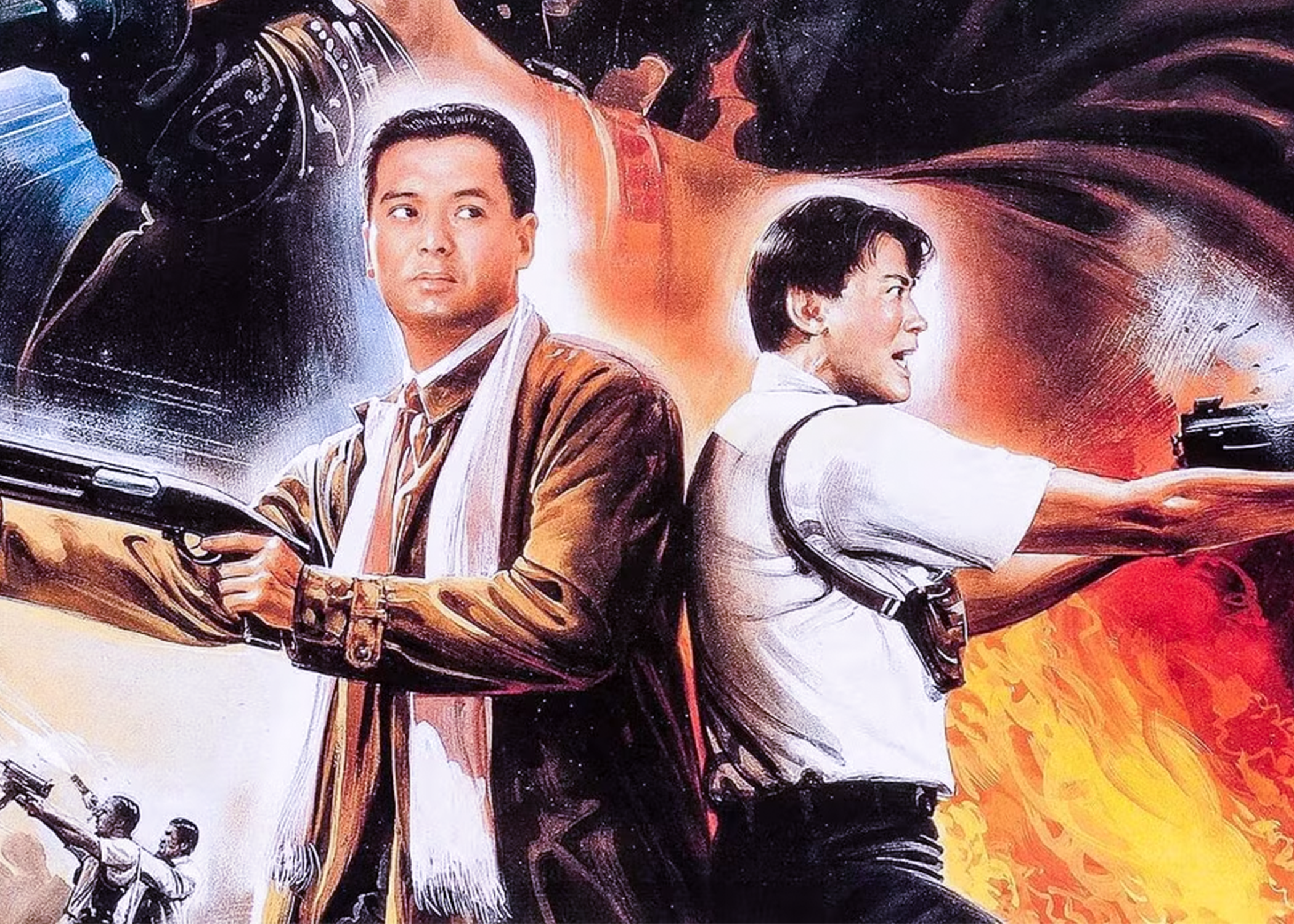
Artwork for John Woo's The Killer. Image property of Magnum Presentations and Film Workshop.
John Woo—the iconic director of the Hong Kong action film sub-genre, "heroic bloodshed"—has done nothing but set iconic trends in the film medium. From downward-upward shots to excessive dolly tracking to dissolve transition editing accompanied by a soft-toned score, he's a cinematic giant. Today, we're staking the Saturn Award–winning director's inadvertent claim to hip-hop history.
But before we step into the rap world, we've got to understand what makes his work so powerful on its own—the kind of director who could even make Quentin Tarantino blush. Woo's got a method of encapsulating the narrative and involving a sense of relative emotion within every frame.
His work had cinephiles feeling staggered by its action-packed narratives and gun-toting protagonists, which came to define the Hong Kong new wave. Through pictures like A Better Tomorrow and Hard Boiled, Woo inadvertently reenergised a then-languishing East Asian cinema landscape, paving the way for rising directors like Wong Kar-Wai and Ang Lee to experiment freely and push boundaries.
By watching three of John Woo's mid-1980s to early '90s films, I began to view things through the looking glass, forming my own opinion of today's cinematic standard. I found myself identifying key elements in Woo's most famous masterpiece and 1989 flick, The Killer—characteristics that not only appear to be basic and overly applied in Western films but also ones that help mould the narrative, threading together a quilt of comfort for sceptical viewers.
My interest began outside the Brooklyn Public Library, while I was waiting for my father to finish printing some documents. In the car, bored out of my mind, I put some earbuds in and scrolled through my hip-hop music library. I've always been a fan of the Wu-Tang Clan, moreso gravitating towards Raekwon and Ghostface Killah.
At the time, I admired founding Wu-Tang member, GZA, for his intelligent wittiness and sharp vernacular. Playing his sophomore 1995 album, Liquid Swords, I was enthused by his sampling of classic kung-fu movies. Almost every song started and ended with a sampled monologue, coating the entire album in a pool of samurai themes.
This inspired me to look beyond GZA and enter an entirely new "chamber". I never knew the technicalities behind the Wu's sound, nor how important it was to incorporate kung-fu samples. I later learned that it became an insignia on every Wu project, for those lucky enough to hear it.
The next album I listened to was Raekwon's 1995 LP Only Built 4 Cuban Linx…, a mafioso rap classic. As the intro track, "Striving for Perfection" played, I was stunned by the calm, desperate and ambitious behaviour of the sound I was hearing. I craved its money talk, slang and tongue-twisting lyricism.
Then came the year 2020, the year that took so many lives and birthed a new outlook on life in one swift pandemic. I was in my third year of high school, locked in the house with nothing to watch, but plenty to play—once again, I listened to Only Built 4 Cuban Linx…, this time with a thorough ear, and realised that it is penetrated with sampled synths and dialogue from John Woo's The Killer.
RZA interpolates the film's narrative—and really, an entire VHS cabinet of movies—by chopping and seamlessly mixing each track according to its plot. From elements of the Blaxploitation genre to Italian organised crime motifs, all are layered upon the firm foundation of the Clan's adoption of classic Chinese kung-fu movies.
Ghostface Killah began his trek to the top with Raekwon at his side, confiding their interests amongst themselves in order to find common ground. Their common ground, you ask? The Killer. After watching the cinematic masterpiece, Raekwon and Ghostface had set both of their minds on getting their families out of hardship and into a life of glamour with immeasurable fortune.
The desperation for stability and a long life of glory made its way into the album's infamous intro—a mantra of agony, stress, perseverance and ultimately success. Making a valued promise to themselves, they then deliver on that very promise once the track "Knuckleheadz" meets the intro's end.
“RZA interpolates the film’s narrative—and really, an entire VHS cabinet of movies—by chopping and seamlessly mixing each track according to its plot. From elements of the Blaxploitation genre to Italian organised crime motifs, all are layered upon the firm foundation of the Clan’s adoption of classic Chinese kung-fu movies.”
A little on the cinematography. In an interview, cinematographer Peter Pau expressed his fondness for working with John Woo, detailing the creative experience between the two patrons of production. He claims that Woo required precision, coordination and perfect timing as he made "…very carefully planned shot lists". Woo had a desire to innovate the look of the average mafia or gun-fu film by exaggerating the most basic attributes that have existed since cinema's conception.
Pau and Woo concocted a method that not only modernised the look of Wong's cinematography in his 1986 classic, A Better Tomorrow, but also performed every shot according to the emotion provoked by both the actors and the score. Woo requested 60 shots a day during the production of The Killer—with half of them being dolly shots filmed by a camera mounted on a wheeled platform.
The excessive use of the dolly is what I believe made The Killer a cinematic masterpiece—a masterclass on how to align the camera's movement with the facial expressions and body language of the actors.
Pau's use of intimate lighting is meticulous. When the camera pushes in on a character's face during a silent scene, it implies severity while signalling a shift in character development. Pau frames the character in a state of emotional and moral disruption, as they begin to reassess those they once trusted. Pau uses a backlight that shifts between two opposing colours—from ice-dappled blues to crisp reds—allowing the key light to isolate a face marked by regret, distress and a loss of control.
It could be argued that Pau's colourful framing helped pave the way for '90s hip-hop–inflected crime films, such as Abel Ferrara's 1990 film King of New York and the 1992 Laurence Fishburne-led Deep Cover. Whether coincidental or not, these films echo a visual and tonal precedent that was clearly established earlier by Woo—blending stylised colour palettes, moral ambiguity and heightened emotional framing within the crime genre.
So all in all, hip-hop isn't fully complete without visuals. Music videos became a conduit into the minds of artists, and directors like Hype Williams and cinematographers like Malik Sayeed pulled as much from cinema as they did from the environments around them. That's where someone like John Woo quietly enters the frame. From the Wu-Tang Clan to the broader culture, Woo's "heroic bloodshed" was creatively co-opted into hip-hop's visual lexicon, forming an unexpected bridge between Black and Eastern cultures.
Purchase the Arrow Video edition of The Killer here.