

A Look At Amazon Prime's 'Invincible' and Its Colourblind World
With the fourth season of Amazon's beloved animated superhero show wrapped up, we ponder what the series says about Blackness in the cosmos and beyond.
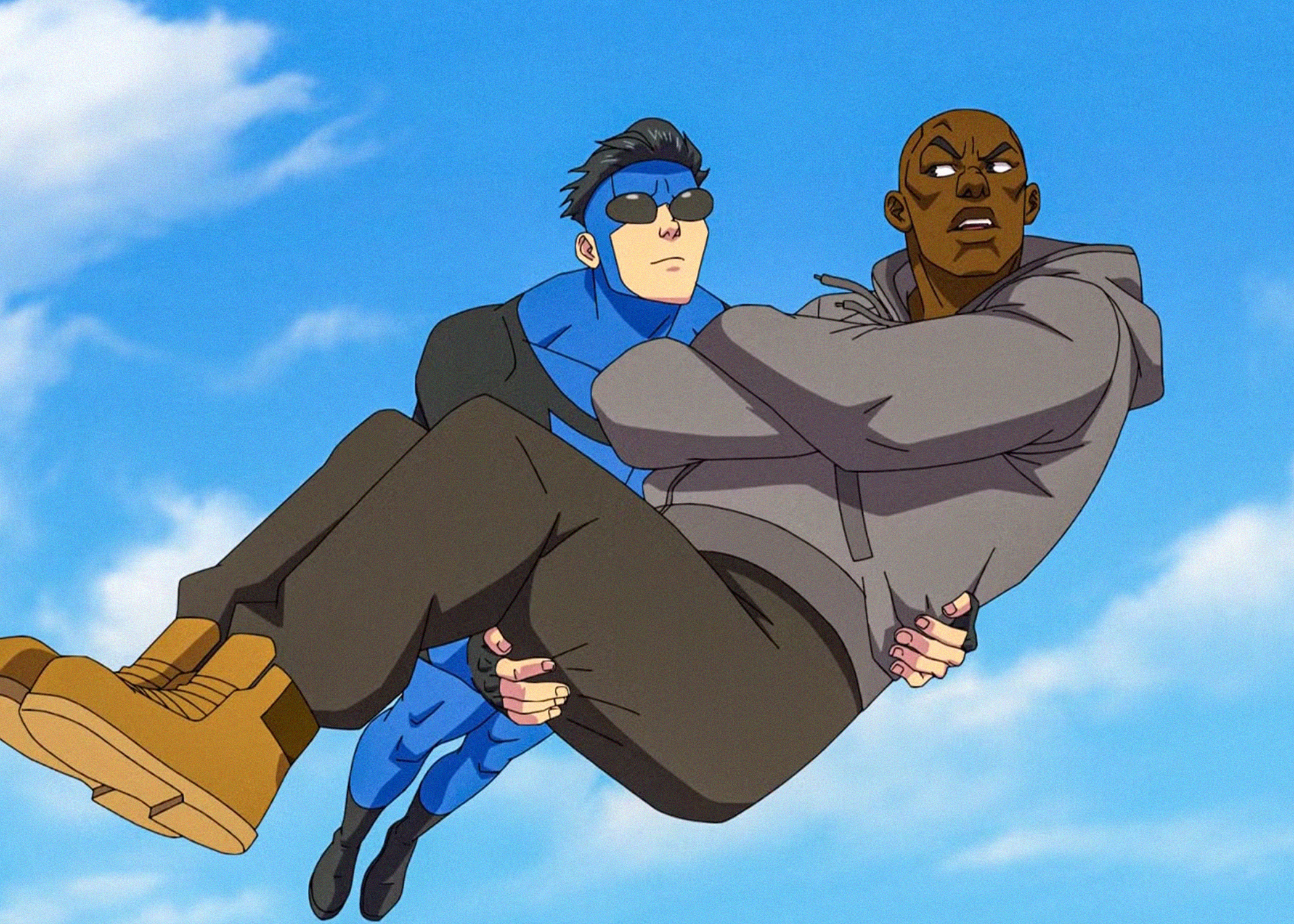
Invincible still. Image property of Robert Kirkman and Amazon Prime Video.
When Amazon Prime Video's animated superhero cartoon Invincible first aired back in 2021, it took the internet by storm. Based on the bloody Image Comics series of the same name, Invincible had everything that fans of the genre could want: non-stop action, compelling plot twists and an award-winning cast of voice actors. Clever and unfiltered, the series stands out as a refreshing instalment to a market dominated by Marvel and DC.
The show follows the titular Mark "Invincible" Grayson as he adjusts to his newly-fangled powers in a world filled with government-issued superheroes and cosmic threats. Along the way, he grapples with traumatic family secrets and the true cost of human mortality in the face of immense power—all with welcome sprinkles of genre satire.
Across its four seasons, the show's creators have made a concerted effort to incorporate a range of identities and ethnicities into the series. Invincible's first girlfriend in the series, Amber, was portrayed by Zazie Beetz. In the series, Amber is depicted as Black—a change from her Caucasian counterpart in the comics. Equally, caped characters Darkwing and Black Samson are also African American, and Mark's best friend William is openly gay.
In an interview with CBR, series creator Robert Kirkman spoke on the decision, saying: "I think representation matters, not to get on a soapbox or anything, [but] especially in the world of superheroes. You don't start getting non-White superheroes regularly until the '70s. Even then, through the '80s, '90s and 2000s, they're still somewhat rare".
Kirkman is spot on in noting that non-White representation in the comic book universe has been historically abysmal. However, there has also been a recent surge in casting for diversity, forcing Black, Brown and Asian narratives that feel awkward and disingenuous.
Invincible, however, has mostly avoided the kind of "diversity pandering" that can make shows insufferable. In many instances, it shows an attempt to implement diversity without doing justice to the nuanced narratives that characters of colour bring to the table.
Rather than have their identities reduced to talking points, the characters of colour in Invincible show can exist as themselves. Still, this broad scope of diversity can sometimes lead to a sense of colourblindness.
My feelings on race in the series are mixed and have evolved over time. When the show first debuted, I was fairly positive about its approach to race representation in Invincible, noting that—even with changes from the source material—there were earnest, seemingly well-intentioned risks taken early on. These included making Amber, Black (a choice that certainly contributed to fan hostility towards her character), and making Mark clearly Korean (while the comics left it ambiguous at best) were deliberate choices that reflected the sociopolitical tilt of U.S. media at the time.
But even with those changes, race remained an afterthought. The show still has an abundance of Black heroes and villains. From the boulderish anti-hero Titan, to the scheming brainiac Angstrom Levy, to the meme magnet himself Lucan, Blackness is present in Invincible—even if it does mostly only come in the form of a generic-looking bald Black man/alien.
The aforementioned villain Lucan's status on Earth became a funny question that grew more troublesome the more I thought about it. Lucan arrives on Earth as one of the most powerful of a race of imperialist, Darwinian extremist, eugenist aliens. He just happens to look like Steve Harvey mixed with Jim Brown and he landed in the United States of America.
A massive Black (looking) man (alien) with a pristine moustache who doesn't understand any of the customs of Earth, much less the United States, would surely run into some issues with race, no? Still, no Viltrumite—the humanoid aliens in the show's universe—ever called Lucan a slur. They seem to have no real concept of skin colour, even as they commit genocide throughout the universe. Just as Titan and Angstrom and Amber just are as Black characters, Lucan just is.
This "race neutrality" seems to be the point, and has been for some time. Back in 2015, Columbia University Film professor Racquel Gates—author of Double Negative: The Black Image and Popular Culture—stated that "the current post-racial, colorblind moment is really a color-mute one… where identity is seen but cannot be uttered." And while people like Shonda Rhimes point to it as a positive, or even a justice, to me, it feels a bit unserious at best and culturally diluting at worst.
I'm not asking for Lucan to go through some Amiri Baraka-style racial awakening once he first realises he's Black on Earth. Of course, I understand that it's a TV show with one-eyed aliens and bug creatures and flying space Nazis. But even superhero and fantasy creators can't present viewers with a world where everything still matters apart from race and culture. That's something fellow Amazon superhero series The Boys has at least tried to do with Jessie T. Usher's fan-favourite character A-Train.
Aside from its post-racial tilt, this season of Invincible has been particularly strong. The early seasons did well to move Mark's moral quandaries along with his killing of the primary Sequid host and Nolan "Omni-Man" Grayson's redemption arc has slowly but surely grown on me. While the episode focusing on the devilish detective-turned side-character Damien Darkblood felt like a filler dud, the four-episode stretch after that was excellent to me.
“Kirkman is spot on in noting that non-White representation in the comic book universe has been historically abysmal. However, there has also been a recent surge in casting for diversity, forcing Black, Brown and Asian narratives that feel awkward and disingenuous.”
The narrative features significant moments that highlight the series' brutality, emotional depth and escalating stakes. It includes characters such as Omni-Man, a Viltrumite warrior and Mark's father, Thaedus, a rebel Viltrumite who opposes his own empire, and Argall, an ancient Viltrumite ruler central to their history. Equally, Mark's brutal brawl with Conquest, one of the most powerful and sadistic enforcers of the Viltrumite empire, adds to the impact of the story.
As far as the animation goes, I don't care that it's good sometimes—it should be good all the time. It's Amazon Prime. They can pay for all of these A-list guest voice actors, but can't make a cape billow in the wind for two seconds? Please. It still continues to be the worst part of the show.
Even still, Invincible has proven itself as a mainstay of the genre, animated or not. And season four provided fans with enough consistent highs to carry them over until next year.
Watch Invincible on Amazon Prime Video here.