

Traversing the Many Worlds of Dawn Richard
The Louisiana singer-songwriter's new LP celebrates everything that makes her whole. From New Orleans' 9th Ward to infinity, Dawn Richard continues to create authentic, unapologetic Creole music, conversing with her ancestors while inspiring those who come after her.
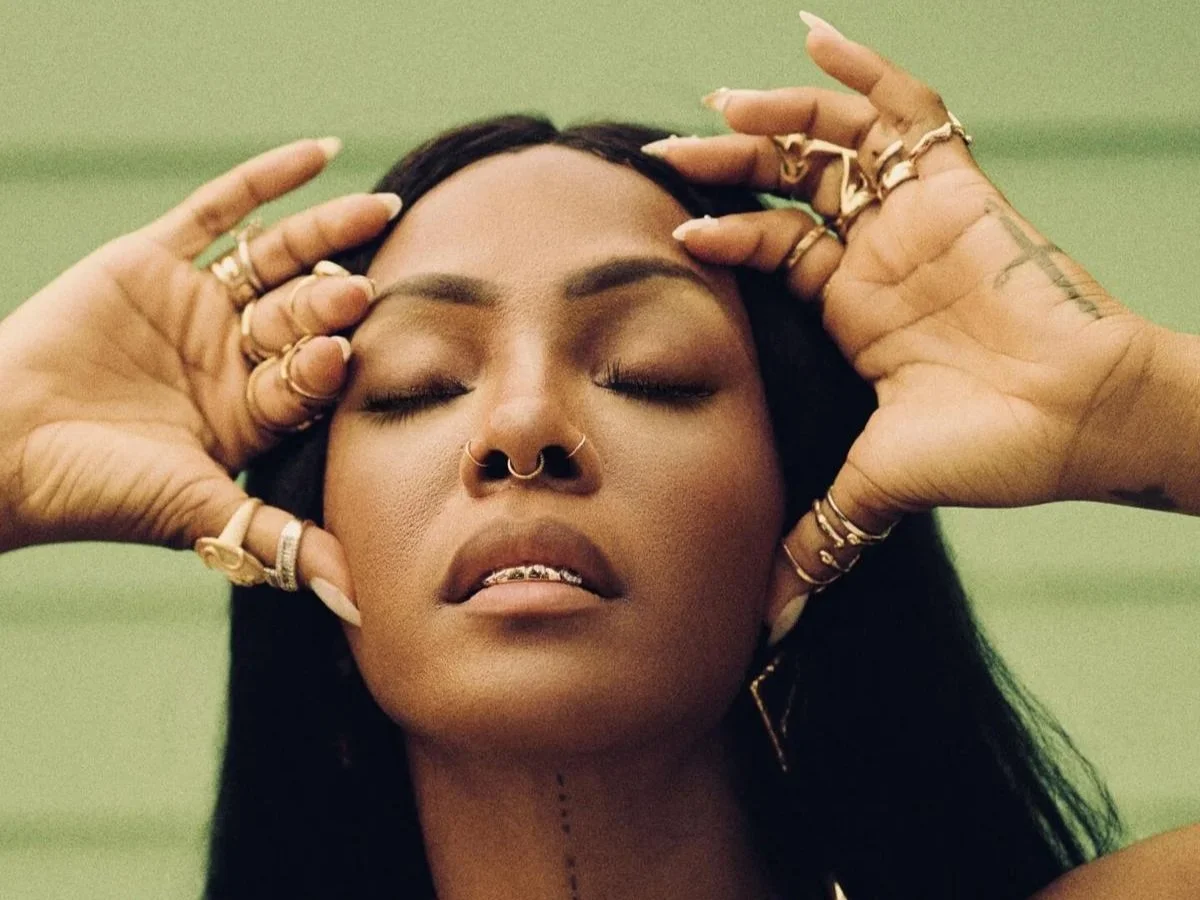
Dawn Richard in 2026. Image property of Justin Williams.
Dawn Richard knows exactly who she is. Our hour-long conversation spanned everything from her early days with Danity Kane, her musical lineage, her views on the confines of genre, Amiri Baraka's Blues People, and her lifelong fight for a sense of self—culminating in her 2024 lawsuit and testimony against abuser and convicted criminal Sean "Diddy" Combs. This gargantuan task served as one of many catalysts for her seventh solo album, Creole Culture.
Richard (that's Ree-shard to you) developed her sense of identity long before the world knew her name. Her musical lineage runs deep. Born and raised in New Orleans, she grew up surrounded by music and movement. Her father, Frank Richard, was the lead singer and percussionist for the funk and soul group Chocolate Milk, while her mother operated a dance school where a young Dawn developed her choreography and singing skills. Long before the world came to know her through MTV's Making the Band 3, music was already a family affair. Her successful 2004 audition led to her joining Danity Kane, which introduced her to millions of fans.
Richard is the consummate artist, born to create. The surreal, Afrofuturistic R&B she's produced since leaving Bad Boy Records is just one chapter of her artistic journey. Her independent streak, however, predates her mainstream success. Under the name Dawn Angeliqué (her middle name), she released her indie debut, Been A While, in 2005, while Danity Kane was still in creative gestation.
The album featured the midtempo jam "So What", co-produced by then-emerging Ne-Yo and penned months before his mainstream ascent in 2006. But Richard has never stayed in a single lane: a decade later, in 2016, Richard began collaborating with Adult Swim and became a creative consultant in 2020, where she advocated for Black animators and artists.
This involvement reflects her creative nature, which conventional boundaries have never limited. Her skills—writing, storytelling, worldbuilding, design—are represented on Creole Culture, and she uses them in a tireless effort to acknowledge the rich past and present of Southern Creole music while charting its future. To me, that's an act of love. Enjoy her conversation with The Culture Crypt below.
The Culture Crypt: I want to talk about the album first. How did you know you wanted to go through with this? What did you gather when you started?
Dawn Richard: "I wasn't in the headspace really to make an album with everything going on in the public, and me being more of a private person. It was very difficult for me to really tap into inspiration. I don't really try to force something. If it's there, it's there, and if it isn't, it isn't. But one thing about me is I'm creating, right? And sometimes those creations don't even find a home—and people know that about me. I had unreleased songs just sitting there, and I wasn't in a place where I felt like I had something to give: I felt drained, but I realised creating was healing me. After about 10 to 13 songs with Katalyst and their drummer Greg Paul, I knew I had something special."
You testified against Sean "Diddy" Combs shortly before you began working on this album. Can you talk about how that process, that gargantuan task, impacted the album?
"Nobody wants to do that. That's the answer. I think if people watched my trial. I wanna make music. I wanna do art and go home. I don't give a fuck about the rest of it; that's really who I am, and I'm serious. And so if anything is not that, it is daunting for me. That is the daunting part. And having to be scrutinised for going through something horrible, and… there are no words. I always tell people, 'If you go back and listen to the music, I told you everything.' It was the only way I could talk. It was the only way I could say what was going on in my life. I was fearful of doing it any other way, and I couldn't.
It wasn't easy, and I don't wish that on anyone—I didn't want to do music at all. That was the first time I felt like I didn't want to be here anymore. I felt hurt and severe depression in the past, but I've never felt that. I wasn't prepared for any of it, and I didn't want to do it. I had no choice. But what I will say is, when the time came, and I felt ready to come back to the mic, I did. That and therapy, severe therapy."
I'm really sorry to hear that. No words could fully convey how traumatising that must've been for you. Still, music seemed to be a positive counterweight that helped you compartmentalise everything. What did you study for this album, and what well did you draw from?
"I started researching New Orleans in general. Like the archive, right? The architecture, the language. And I started thinking about autonomy, being stripped of something and the will and want to tell a story. I realised that in New Breed, I had been telling my father's journey, and Second Line was this feminine energy—my mom's journey—how I became Creole through her lens. It started to feel like I was finally seeing what it meant to be from this city through my own lens."
You paint as well, right?
"I'd actually been doing a lot of painting around that time, and I'd even been accepted into a residency in Iceland. As I was painting, I realised, yo, this is a triptych. These panels could live by themselves. You could put them on a wall or play them, and they could stand alone. But when you put them together, you realise they're a full piece. That's what Creole Culture became.
The more I researched Cuddini, the French, African, and Indigenous relationships in New Orleans, and the sounds of the city that began with Creole music and the African drum, the more I realised there was a story to tell. I looked up modern Creole stories and music in pop culture, but it was all so old. Then I looked up how many women were telling Creole stories in modern culture, and they had, like, Beyoncé and me. Still, there weren't any modern-day conversations around a full album that spoke to the history of New Orleans in this way—and made it progressive."
That's so interesting. Listening to the album, I noticed this active dialogue between past and present. There's the Sister Nancy moment, the Aretha Franklin "Daydreaming" interpolation, and so much that feels new. You've clearly considered New Orleans' history and its place in the present. What does that mean to you?
"It's not just a New Orleans thing, right? It's not just, 'Oh, here comes Dawn, another New Orleans record.' That's not what I'm doing. I'm trying to show people that New Orleans is more than you think. People from all over the world visit the city and take something from it. The point is: Creole culture is pop culture. You hear it in the language, slang and accents, and see it in the way people from the South dress. That's why they're making such an impact. It all comes from our collective archive.
Creole culture today is baggy jeans, gold grills, and locs. It's knowing Juvenile and Wayne's songs by heart. It's your love for Beyoncé, her singing and that alto tone she speaks in. That's her Louisiana culture, right? It's why you love Solange and how she moves in a different lane from everybody else. There's something innately beautiful about how people gravitate toward Southern culture.
“The point is: Creole culture is pop culture. You hear it in the language, slang and accents, and see it in the way people from the South dress.”
It's not just Louisiana. Creole culture spans the Mississippi Basin. It moves through the church, the gospel you hear in the music, and Aretha Franklin's soul. It moves through the Caribbean, which is why I have Sister Nancy, and through Haiti and the Dominican Republic.
I'm trying to show people that you love it not just because of its past. It's because you still see it in everything you do. You hear it when Drake puts bounce into his music with Big Freedia. That 'yeaaah baby,' that 'ya heard me'—they're putting it in their music. Yat speak, because that's what we call it, comes from the original language, Kouri-Vini, which fewer than 10,000 people speak now. So they intentionally put it in the interludes, bringing something dying in New Orleans into the present. You hear that same essence in La Reezy. All of it is derived from something Indigenous, African and Creole."
Did you always know you wanted to be an artist, this kind of artist?
"I've always been New Orleans, even from Making the Band. I'm just doing what comes naturally to me, but I didn't realise it would sound so different to everyone else. People would always say, 'This doesn't sound like anything else.' That wasn't on purpose. I never knew I'd get the response I did by choosing my own sound.
I took everything I loved—from progressive music and Björk to Imogen Heap and rock—and made it mine; I gave it that NOLA thing. I know the other girlies can put albums together and you can hear where they're derivative of each other, right? Mine doesn't do that. And that's either a really great thing, or it means my music won't always feel relatable to everyone. But I'm gonna have my own sound every time. It's not gonna be what everybody else is doing. It just isn't."
You mentioned Björk and Imogen Heap. Can you speak about the tension between Black music and alternative music, particularly this narrative that it's unexpected for Black artists to draw from those influences?
"But our people are hip, though. Look at artists like Kelela and PinkPantheress. Black people know Crystal Waters and Donna Summer, the Black pioneers who paved the way for house and dance. But we also recognise Skin from [the British band] Skunk Anansie, Brittany Howard from Alabama Shakes and these incredible Black women who've pioneered rock music. Let's stop perpetuating the idea that Black women are unaware of the alternative artists who have influenced their careers.
“Let’s stop perpetuating the idea that Black women are unaware of the alternative artists who have influenced their careers.”
And now, all of a sudden, there's this beautiful acceptance of Black women across multiple genres. I find it beautiful, but let's not act like I ain't been screaming this shit since 2005. The truth is, Björk and Imogen drew influence from soul music, too. I'm a Black girl who started in a multiracial pop group. We had a hit dance record, and the next was with Yung Joc. We've always been doing different things."
We talked about when you first joined Danity Kane. You were in your early 20s. What are the biggest changes you see between the artist you were then and who you are today?
"I was having a conversation with someone from my past. Very few of us are still talking after everything we've been through. He said, 'I remember you back then. You were so timid, so quiet.' I told my therapist how much that hurt me. I don't think he meant it negatively, but back then, I was grateful. Grateful for everything. I was preyed upon in that way, made to feel that as a young Black woman, I should be grateful just to be sitting at the table. So I let people stomp all over me because I was afraid that if I spoke up, I'd be labelled 'the bitch'.
As Black women, we didn't have the luxury of saying, 'I'm not happy.' We had to walk a fine line. Speak up, and you'd be the bitch. You'd be fired. Even our own Black peers and superiors made us feel that way. We're taught so young to be grateful. You could be a summa cum laude valedictorian and still be told to be grateful for getting into an Ivy League. But we deserve to be there. That's why you never saw me relaxed on television. It was always, 'This is one shot. Don't let it go.' That was the mentality.
But as a grown-up today, I am not that girl. I recognise the difference. I have autonomy, and speaking up and being my own boss is imperative. I don't give a fuck if I'm labelled the Black bitch or whatever it is. I will not pander. I will not do it. Now, I wear the scrutiny like pearls, babe."
Stream Creole Culture below: