

Still Competitive: B-Real on 30 Years of Cypress Hill and the Making of 'Dios Bendiga'
Thirty years deep into one of hip-hop's most influential catalogues, Cypress Hill frontman B-Real sits down to talk brotherhood, the album that never got its flowers and the perfect timing of their new project.
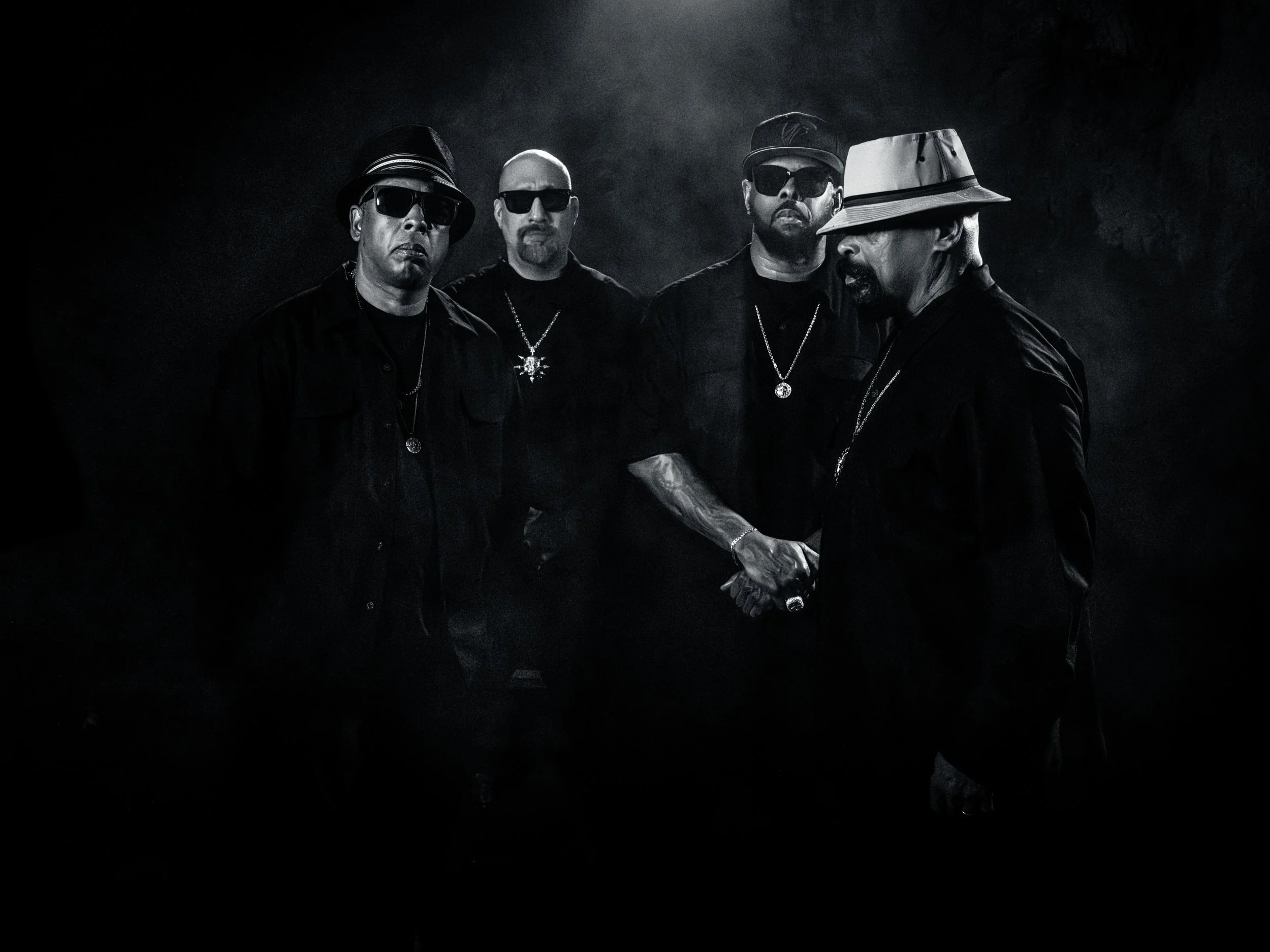
Cypress Hill in 2026. Image property of Travis Cox.
Thirty years since Cypress Hill first pushed that nasal, dark hip-hop sound into the mainstream, B-Real is still talking like a man with so much to prove. With an extensive catalogue running from their self-titled debut through to Black Sunday, they've now given us Dios Bendiga, their first entirely Spanish-language studio album, produced by DJ Flict with Eric Bobo as musical director.
It's a record 30 years in the making, an idea that first surfaced around 1999's Los Grandes Éxitos en Español compilation album release and kept getting pushed back by touring schedules, label indifference and albums the group were contractually obligated to finish first. It finally came together during a rare gap in the road roughly a year and a half ago, and B-Real is candid about why the timing mattered beyond scheduling. Amid renewed targeting of Latino families by ICE, he frames the album as a statement of identity.
Thirty years is a long time to stay excited about anything. However, B-Real doesn't sound like someone fazed by how long he has been doing this. When asked what still gets him fired up about making records this deep into Cypress Hill's run, he doesn't hesitate.
"I think it's a couple of things, because we are artists, the desire to be creative never really goes away as long as you still love doing it. And we still love doing it." The other half of it, he explains, is a competitive streak that's never switched off. "How does our music fare with everything out there at this time? We always want to be competitive."
A decision that traces back to an idea DJ Muggs had for the group decades ago, one they ultimately abandoned, is the indirect reason for the group's longevity. "What a lot of people don't know about Muggs's plan for all of us was that the vision initially was we make the first few albums together and then everybody sort of spans off," B-Real explains, comparing it to the model Wu-Tang Clan would later follow. "That necessarily didn't happen. We sort of stuck with the group thing." Looking back, he considers it one of those quietly defining calls a group makes without realising it at the time. "I think it made the group stronger for doing that. I don't know if we have the same sort of staying power if we had done it like that."
A discussion about the songs that made Cypress Hill a household name shifts his tone into reverence. "How I Could Just Kill a Man" was meant to be the safer of a double A-side, with Sony pushing "The Phuncky Feel One" as the lead single first. It flopped. DJs gravitated to the other song instead, and the label flipped the promotion. "That song pretty much saved us from obscurity."
He remembers watching it soundtrack a scene in the 1992 film Juice and feeling the room react the same way it had during the Crush Groove finale years earlier—the one time before that he'd seen an entire cinema get up and move to a song playing on screen. "I knew that we were happy that that song had an impact—that song changed our lives, really."
B-Real continues: "We went from obscurity to now we couldn't go anywhere. Then, 'Insane in the Brain' finished the job." A question was put forward about whether performing songs like 'Insane in the Brain' had lost its novelty, and B-Real continued his theme of reverence to their catalogue. "We know what that song did for us. We know what it means to our fans, you cannot fall out of love with what gave you the light."
Black Sunday itself came together in a three-month sprint in New York, a fraction of the three years the debut had taken, after Sony pulled the group off the road to chase their momentum. Two songs were pulled from earlier, lesser-heard sources to round out the tracklist, including a lyrical remix of "Hand on the Pump." "We kind of cheated there," he admits, laughing. He calls the sessions a kind of flow state, the point where his style properly clicked into place, while Muggs was quietly betting the group's whole career on albums over radio singles. "Traditionally Cypress Hill has sold more albums than we've sold singles."


The voice itself—nasal, pitched-up, instantly recognisable—is an origin story he clearly still enjoys telling. The group were fans of the artist Rammellzee, who alternated between a low speaking tone and a sharper, higher one. Sen Dog's brother, Mellow Man Ace, suggested B-Real try the pitched-up register while the group worked on "Real Estate." "I'm like, really? You think he's gonna like that?" he remembers asking Muggs. "Well, fucking try it. And so I tried it, and Muggs liked it." Turning it into something he could deliver live without shredding his throat took three years and a vocal coach, a former opera singer named Elizabeth Sabine.
That same instinct for reinvention runs through Dios Bendiga. For B-Real, the timing was never just about finally finding a gap in the road. "More than anything, it was about taking a stand with all this shit happening here at home, like them targeting Latin families and Latin folks with ICE. We're fucking Latinos, we're natives—and we're going to stand up with this music right here." He's unbothered by the idea that an all-Spanish record might cost the group English-speaking listeners, comparing it to his own habit of listening to French hip-hop without understanding most of the words. "When it sounds good, it sounds good regardless."
When asked what his 20-year-old self would make of the new record, B-Real doesn't pretend he'd have understood it. "The 20-year-old version of me wouldn't have been able to process this album. I was in a very dark place." He traces his narrower tastes back to an era when hip-hop artists closed off other genres almost on principle. His own palette has widened considerably since. "I did not have patience for jazz in my 20s. Now I have to have a steady diet of classical music and jazz."
“The 20-year-old version of me wouldn’t have been able to process this album.”
That evolution feeds his only real piece of advice for artists coming up now, particularly ones tempted to keep chasing the sound that first made them famous. "The enemy of any artist is redundancy. In the beginning, people might be all amped on it. But after a while, some of those same fans are going to be like, you need to do something different. And if you just keep doing the same, people fall off."
Dios Bendiga proves that Cypress Hill aren't ready to view their legacy as a preserved museum piece. The group's competitive drive that brought them to this point is still very much alive. Their desire to create the art they envision continues to push their legacy forward. Dios Bendiga marks another chapter in that evolution, and one more instalment in a story B-Real clearly has no intention of finishing anytime soon.
Stream Dios Bendiga below: