

Mahershala Ali carries a sword, a swaddled baby and his sujood in Bassam Tariq's drama, and Hollywood finally lets a Black Muslim father be a hero.
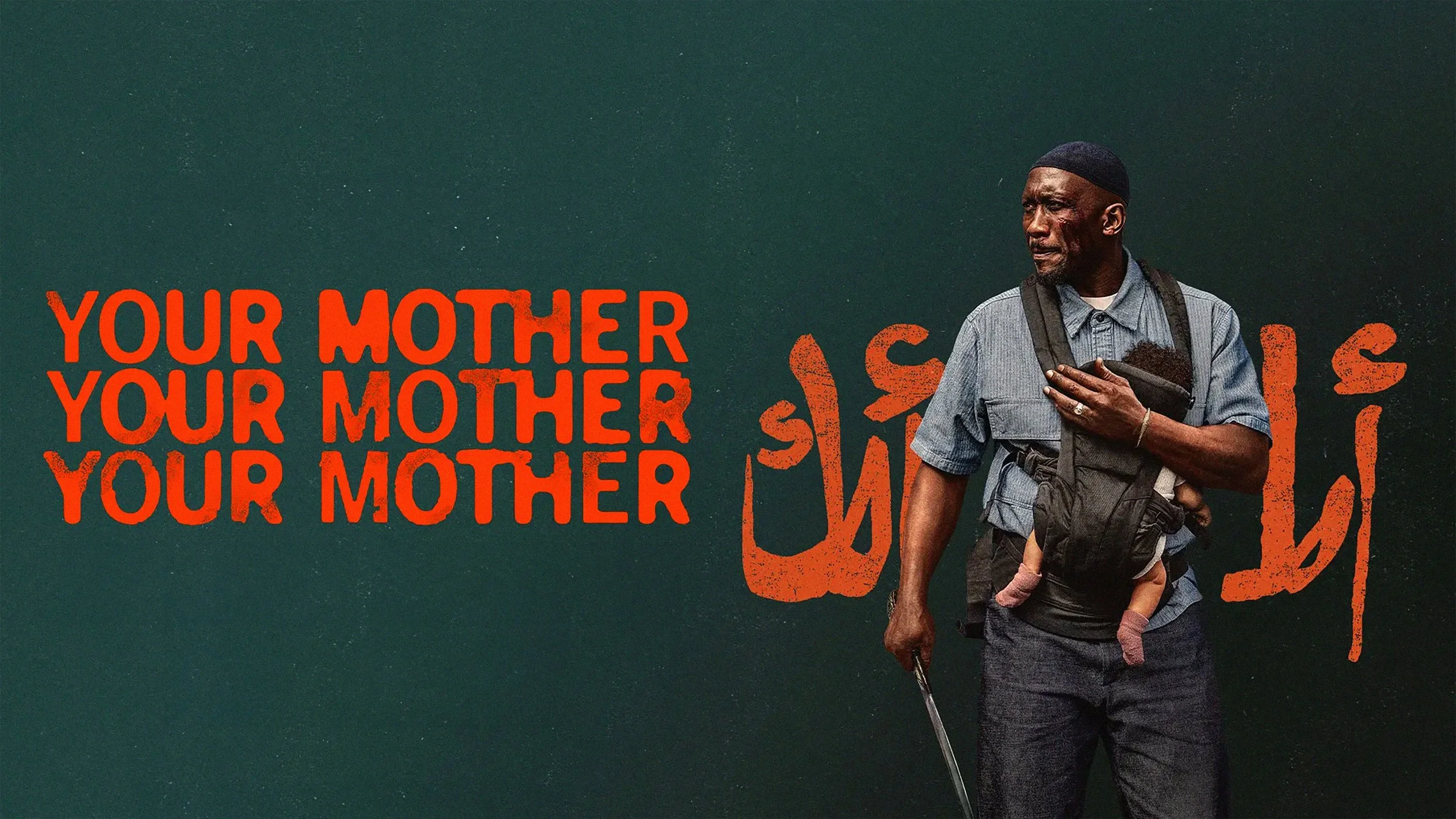
Promotional poster for Your Mother Your Mother Your Mother. Image property of Amazon MGM Studios.
Every conversation about Your Mother Your Mother Your Mother seems to begin with a film that doesn't exist. Bassam Tariq was the original director of Marvel's Blade reboot, with Mahershala Ali set to play its daywalker. Tariq left the project in 2022, and his replacement, White Boy Rick director Yann Demange, later exited too, leaving the film in limbo. But Tariq and Ali took the sword training, the partnership and the ambition elsewhere—and the coverage has duly followed the script, with headline after headline crowning this the Blade film Marvel fumbled.
I understand the impulse, but it grades Tariq's film on Marvel's curve and badly undersells it. Your Mother Your Mother Your Mother is not the Blade we were missing. It is the film we didn't know we were allowed to ask for—and it is a masterpiece.
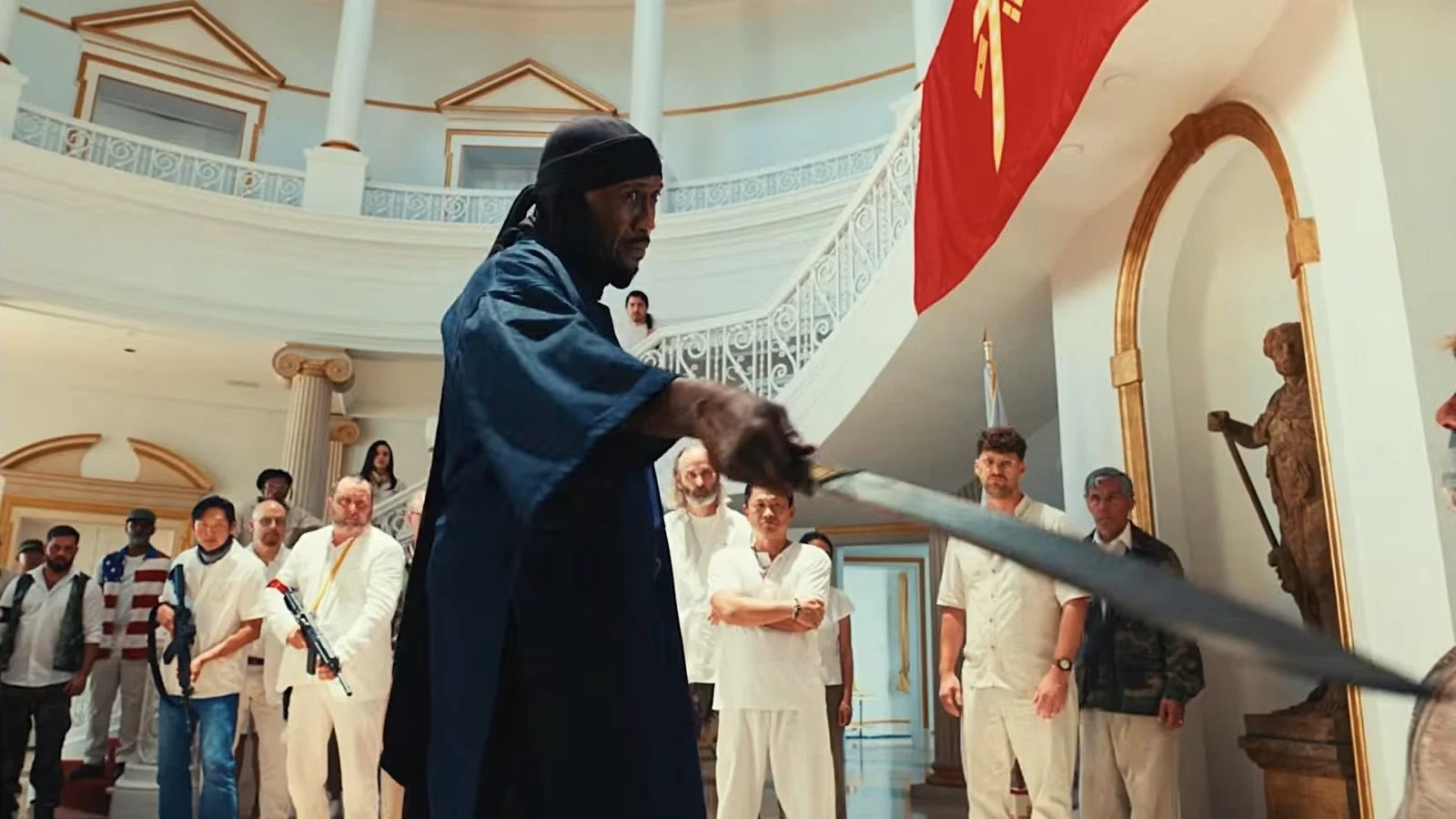
Latif (Ali) is a Houston hitman and a devout Muslim; when his wife, Adia, dies suddenly, he is left with three children: teenage Fatiha (Adia), younger son Qadir (Jahleel Kamara) and baby Aziza, who cannot keep formula down. What follows is less a revenge odyssey than a supply run. Latif crosses the city hunting for breast milk with his infant strapped to his chest and a sword within reach. Early on, he kills a skinhead and wipes his blade clean with a baby wipe. The whole film lives in that gesture: brutality and compassion coexisting in one hand.
Tariq builds every key scene around that hand. The film opens with Latif committing a murder in a public restroom, then follows him to the masjid, where the same hands are raised in prayer. Later, he stands in the masjid with his newborn in his arms, unable to fully go into sujood (meaning prostrate)—the hands that kill for a living are now needed to hold his daughter. Tariq never asks us to resolve the contradiction. He asks us to sit with a man who contains it, and that is what makes Latif who he is.
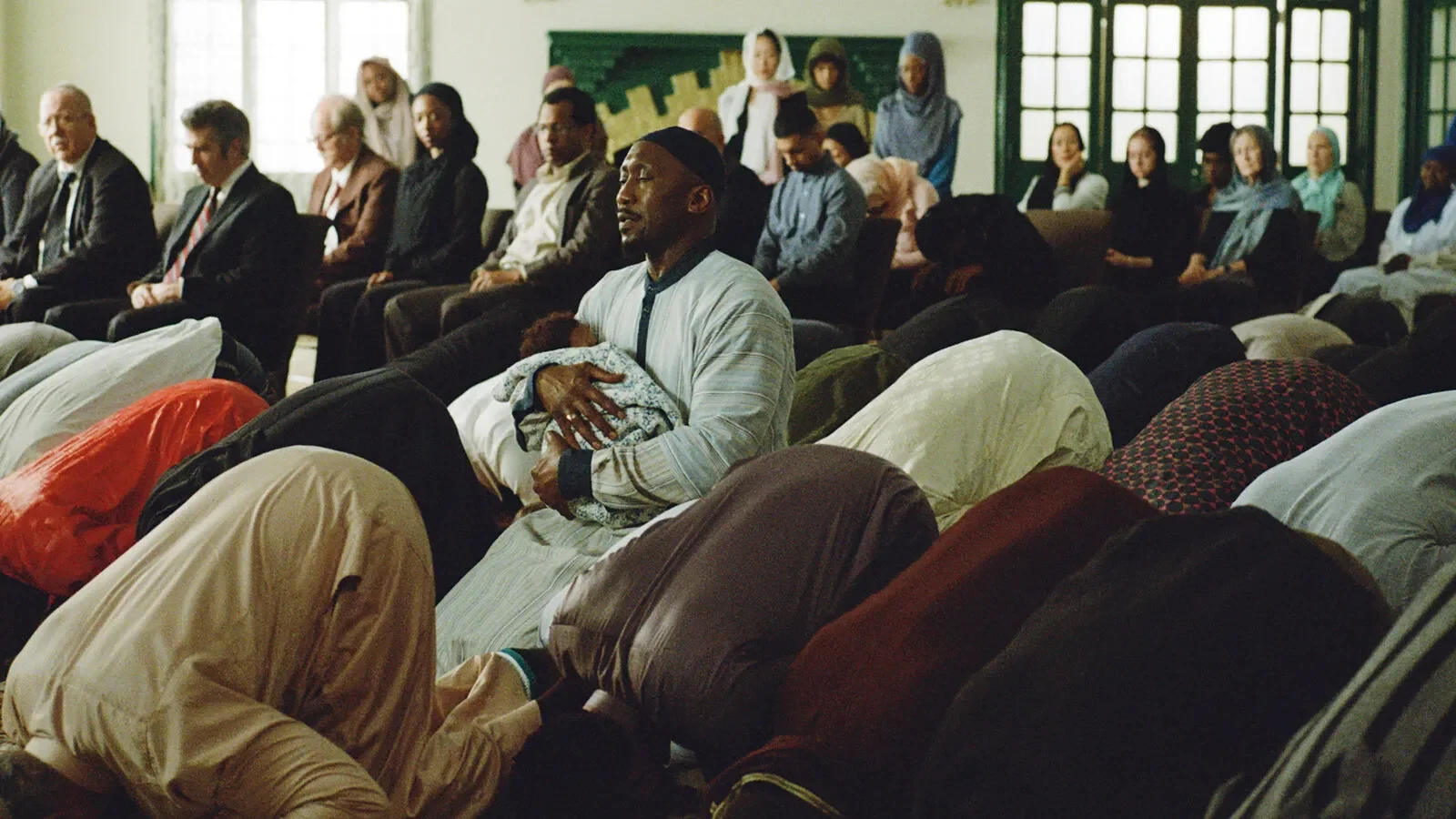
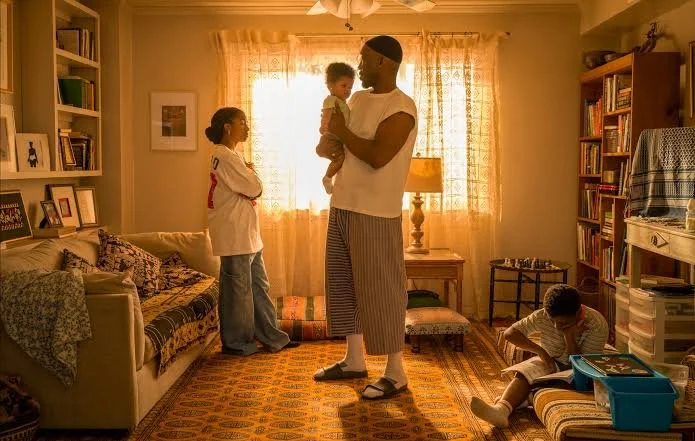
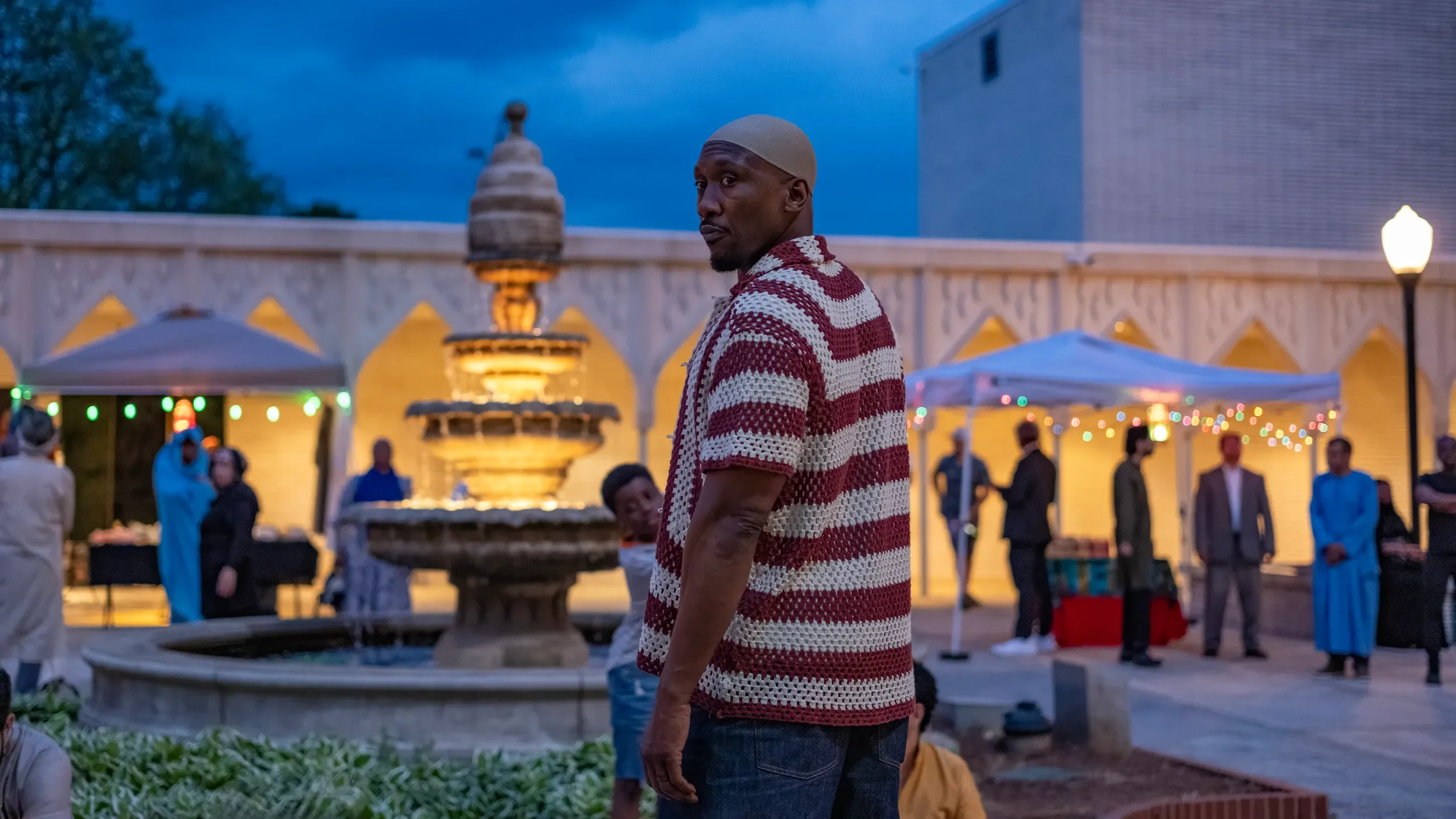
Cinema has rarely let Black fathers be this complicated. Black men have been handed violence—the enforcer, the gangster, the cop—and tenderness mostly in service of someone else's story: the mentor who dies in the second act, the friend who steadies the White lead. When Black fatherhood does take centre stage, as in Fences or King Richard, it is confined to prestige drama and rarely trusted with genre. A Black father holding violence, grief and faith in one frame has been kept on the periphery of the narrative.
Meanwhile, White versions of Latif are everywhere. Road to Perdition gives Tom Hanks a Catholic hitman on the run with his son, his faith treated as moral weight rather than menace. Equally, the original The Godfather cuts Michael Corleone's murders against a baptism—sacrament and slaughter in one sequence—and is canonised for it. John Wick turns a widower's grief, carried in a puppy from his late wife, into a franchise. Léon: The Professional gives its hitman a child to protect and a carton of milk; Taken and Logan give their killers daughters worth dying for. These men are allowed to be murderers and mourners, sinners and believers. Their contradictions are read as depth. Latif's would usually be read as threat.
“A Black father holding violence, grief and faith in one frame has been kept on the periphery of the narrative.”
That double standard has a name and in Orientalism, Edward Said argued that the West built its image of the East as an object to be looked at and spoken for, never a subject able to speak for itself. For more than two decades, Hollywood's Muslim has lived inside that gaze: the terrorist, the informant, the silhouette in a rifle scope. A White hitman's rosary is interiority; a Muslim's prayer mat is a warning sign. Tariq—whose Mogul Mowgli already put a British Pakistani rapper's body and faith under the microscope—overturns this by granting Latif what the genre gave Michael Corleone but withheld from men who look like him: an interior life. His Islam isn't exotic. It is as Texan as the freeways he drives, practised in kitchens, car parks and funeral prayers.
Here the Blade comparison finally becomes useful, at a level deeper than swordplay. Blade was always caught between two worlds—half human, half vampire, trusted by neither. Latif lives at a more honest crossroads. He is Black and Muslim in an America that has made each a suspect category, and Tariq refuses to let either identity stand in for the other. When Islamophobic gunmen massacre worshippers at a Black mosque, the hatred lands on Black bodies as much as Muslim ones; the people pulling the trigger have never needed to tell racism and Islamophobia apart.
The film is dense with detail Muslim audiences will clock instantly. Imam Abdul Malik (a beautifully restrained Giancarlo Esposito) cherishes Latif's family but will not bless how he earns his living. Fatiha has stopped believing and refuses to fast or pray, while Qadir clings to the rituals their mother taught him, answering the call to prayer even when his father won't. The imam reminds Fatiha that her mother chose her name on purpose. Doubt here isn't the opposite of faith—it is part of how faith is lived.
Opposite Latif stands Pastor Hwan (John Cho, superb), a veteran of America's forever wars who believes he survived because his mother prayed for him, and who now wages his own crusade across Houston. Their paths cross over Hatty, a pornographer whom Hwan accuses of trafficking women for his films. Latif snatches Hatty, a handover at the strip club Hwan has converted into a church collapses into violence, and the pastor vows to make him pay—a promise that brings his holy war to Latif's own place of worship.
Cho makes Hwan's faith frighteningly sincere rather than hypocritical, and that is what makes him dangerous: this is no cartoon zealot but a grieving soldier who has mistaken survival for a mandate. Cho and Ali play two men fighting two holy wars in one city, and their scenes crackle because each sees himself in the other—the same devotion, the same violence, pointed in opposite directions. Hold on to that detail about a mother's prayer.
The title comes from one of the best-known hadith in Islam, in "The Book of Miscellany". A man asks the Prophet Muhammad ﷺ (peace be upon him) who is most deserving of his good companionship. "Your mother," comes the answer. Then who? "Your mother." Then who? "Your mother." Only on the fourth asking does the Prophet say, "Your father." This is the film's thesis. Latif ranks fourth, and with his wife gone he must fill a role weighted three times over—the hands that wipe a sword must now warm a bottle. Fatiha, meanwhile, becomes the eldest daughter forced into motherhood overnight. In one of the film's most devastating scenes, she reads this hadith aloud to Qadir as they wait to learn whether their father is coming home.
Spoilers Follow...
Most discussion stops at the hadith. But in fixating on the title, people miss the Qur'anic key Tariq has hidden in plain sight: the daughter's name. Al-Fatiha—"The Opening"—is the first surah of the Qur'an, which the Prophet ﷺ called its greatest. Muslims recite it in every unit of every prayer, at least 17 times a day. It is recited over the sick for healing, which is why one of its names is Al-Shifa, "The Cure". Above all, it is known as Umm al-Kitab: the Mother of the Book.
So a film titled Your Mother Your Mother Your Mother gives its heroine the name of the surah Muslims call the Mother of the Book. When Latif lies near death in the final act, Fatiha prays for him, and he wakes. Asked who was praying for him, he answers in two words: "My daughter." The circle closes. The pastor was saved by his mother's prayers; Latif is saved by Fatiha's. The girl who stopped praying becomes the prayer—and the film that began with one hand holding a blade and a baby wipe ends with a daughter's hands raised in du'a.
Ali is commanding throughout—stoic, wry and wounded at once—but Adia is the revelation, carrying the film's emotional centre with fury and tenderness in equal measure. Tramell Tillman and Tiffany Boone make vivid impressions in supporting turns. Katelin Arizmendi's cinematography renders Houston sun-bleached and strangely holy, and Son Lux's score hums with grief. When the action comes, it is heavy and brutal, every exchange felt in the bones. Yet Tariq knows the sword is the least interesting thing in his film, and wields it accordingly. The swordplay is the hook; the faith is the film.
Marvel lost a Blade film. In its place, we gained something rarer: a Black Muslim father who can be an action hero, a sinner, a mourner and a man of prayer in the same frame, given the dimensionality cinema has handed his White counterparts for decades. Salvation arrives not from a hero's blade but from a daughter's du'a. Stop calling it the film we missed. Your Mother Your Mother Your Mother is the one we needed.
The film will hit cinemas across the UK and Ireland on November 20th.