

Exploring Mobb Deep's 'Infinite' and the Ethics of Unconsented Art
Investigating how AI and unconsenting scraps of material are reshaping the afterlife of creative endeavours.
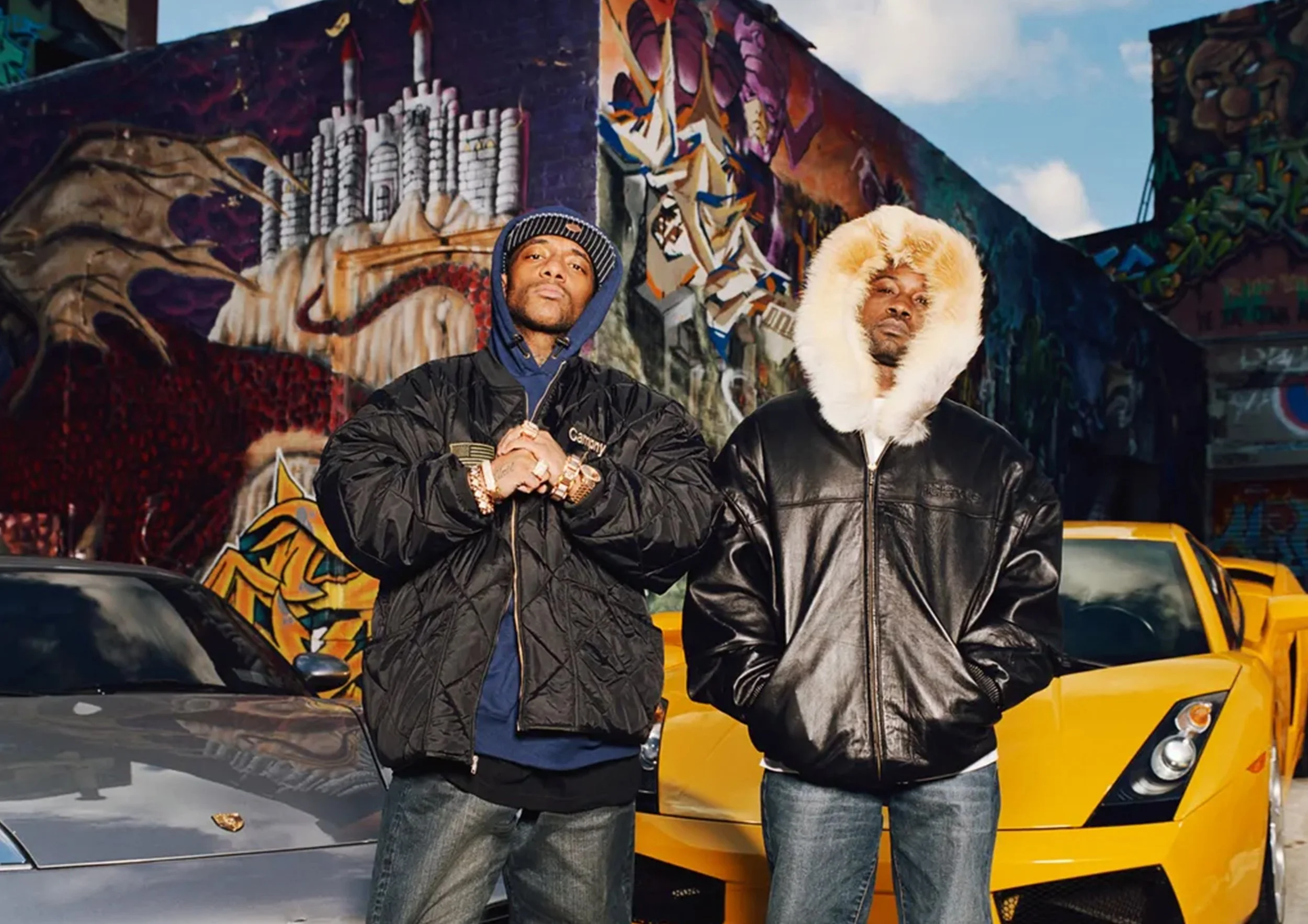
Prodigy (left) and Havoc (right) of Mobb Deep. Image property of David Yellen and Getty Images.
Hearing Prodigy's voice on a brand-new Mobb Deep album in 2025 is somewhat of a ghost story. On the duo's Mass Appeal-backed reunion LP Infinite, the late Queens emcee's voice cuts through the jazz-flecked, soulful single "Us Against The World" like butter. It's sharp, familiar, rhythmic and everything you expect from one of hip-hop's most decorated rhymers. But beneath the thrill is a ripple of dissonance.
Here, in 2025, we have a man who passed away in 2017, and he's still—somehow—making music, dropping verses and wailing in a purgatory-shaped stockade. Arguably, not enough people are pausing to admit how unsettling this all is.
Posthumous creativity has become a significant part of contemporary culture. Albums are now released years after an artist's death, and actors are digitally resurrected for blockbusters like Oliver Reed or Peter Cushing in 2000's Gladiator and 2016's Rogue One: A Star Wars Story. Not even the stage is safe. Performers have been reanimated on festival stages as holograms (we're looking at you, Tupac Coachella hologram). It's not new—but the way it's evolving is.
The release of the fittingly titled Infinite is a reminder of how normalised the uncanny has become. It's one of many entries in Nas and Mass Appeal's Legend Has It... album saga, following releases from fellow deceased rapper Big L (whose work also fits squarely within this analysis) alongside solid releases from Raekwon and Slick Rick, to name a few.
What would once have felt transgressive now arrives to applause, trending hashtags, and nostalgic celebration. Yet there's an unease at the heart of it. Prodigy isn't here to agree, disagree, negotiate, refuse or give the slightest nod of approval. His voice is, but he isn't. That split: between the artist and their digital residue is where the ethical tension lies.
Posthumous albums have existed for decades. Amy Winehouse had one. Mac Miller had a few. Tupac had one too many, and Juice WRLD's estate is still releasing material. Traditionally, these projects relied on demos, archived sessions or unfinished recordings. What we heard was, in some meaningful way, a trace of the artist, a moment they actually lived through.
But we've crossed into different territory. The rise of digital resurrection has changed the landscape entirely. Michael Jackson "performed" on stage with Justin Timberlake years after his death, a hologram rendering of a man long gone.
The late Paul Walker appeared in 2015's Fast & Furious 7 through CGI face-mapping, body doubles and crafty editing. Marvel's 2022 superhero sequel, Black Panther: Wakanda Forever, had to negotiate—narratively and culturally—the absence and presence of Chadwick Boseman. Even these examples, though still uncanny, were grounded in footage or facial scans. They were built from something the performer left behind. Now, technology requires nothing.
AI voice models can clone a voice in seconds. Deepfake CGI can recreate expressions that never existed. Producers can feed an algorithm an archive of vocal stems and generate new verses that sound convincingly like the dead. A future album by a dead artist no longer needs care and dedication—only data.
This shift forces a blunt question: who owns a person's voice once that person no longer exists? Is it the labels? An artist's estate? The fans? The algorithms?
The law hasn't caught up, and the culture is sprinting ahead without waiting. The music industry has always exploited labour, but AI introduces something stranger: the potential for infinite labour. The digital version of an artist does not age, rest, burn out or dissent. It can produce forever. The gig economy of the dead is frictionless. And corporations know it.
This is no longer hypothetical: during the Drake-Kendrick feud, the estate of Tupac Shakur threatened legal action against Drake after he released an AI-generated diss track using cloned vocals of Tupac and Snoop Dogg without consent. The incident exposed a legal vacuum in which a deceased artist's voice can be repurposed for contemporary cultural conflicts, raising unresolved questions about ownership, labour and posthumous agency.
Hollywood treats deceased actors like suspended assets. The music industry treats human voices as renewable resources. Fandoms, driven by nostalgia and parasocial devotion, demand more and more, even when it requires digital necromancy. There's a difference between commemoration and continuation. A tribute honours a life. A hologram or deepfake often extends it for profit.
Even journalism is flirting with the boundary. Conversations are emerging about recreating the voices of dead critics or analysts, allowing their commentary to 'continue'. But the most unsettling part isn't the technology. It's our comfort with it. We barely hesitate when a dead star appears in a new film. We barely blink when a posthumous album drops. The uncanny becomes tradition. In this way, the resurrection becomes a business model.
Consider how quickly we normalised AI-generated tracks of one artist singing another artist's song. How easily a synthetic pop star can top TikTok. How casually producers discuss reconstructing vocals, like a sonic amalgamation of Frankenstein's monster. We're less interested in whether the dead can speak, and more in whether they can produce hits. We fear endings. We resist closure.
We want our icons to be infinite, even if it means flattening their humanity into a data set. For estates, the decision often carries emotional and financial complexity. Families need income. Labels want returns. Fans wish the artist back, even if only as an echo. But where is the line between honouring someone's legacy and puppeteering it?
Case in point: on November 28th of this year, FAMM (Jorja Smith's record label) publicly warned via Instagram that "we are in uncharted territory. AI is all around us and is already impacting the way we consume music." This statement came after the viral track "I Run" was allegedly found to feature an AI-generated, diluted replica of Smith's voice, leading listeners to believe it was a new single. The incident makes clear that artistic labour has become a reproducible asset, which can be extracted indefinitely, long after, or, in this case, regardless of legal consent.
In the eyes of the late German philosopher Karl Marx, "dead labour" described the accumulated products of past human effort that capital could reactivate and own, profiting from them. In an AI context, dead labour is biometric and affective. A voice, once a unique instrument tied to embodiment, can now be revived, multiplied and sold.
Prodigy's voice, like so many others, is now part of a system larger than himself. A system that can resurrect at will. A system that collapses the distinction between living labour and dead labour: a concept Marx never lived long enough to imagine.
What's striking is that many artists predicted this. Prince warned about digital ownership for decades. Whitney Houston refused hologram performances while alive; her estate approved them after her death. Robin Williams legally prohibited Disney from using his outtakes for future films.
Artists know their likeness is power. In the wrong hands, it becomes a resource rather than a right. And yet, the ethics are rarely discussed. We talk about innovation, nostalgia, fan service and IP management. We seldom talk about consent after death. Consent is the heart of the matter.
A dead artist can't say yes. A dead artist can't say no. A dead artist can't decide what they would want their voice to do, or whether they'd like to appear in a film they never read, rap over a beat they never heard, or have their image stand beside someone they never met.
What we are resurrecting may sound like the artist, but it isn't the artist. It's a simulation of possibility. A simulation someone else controls. That's why the Mobb Deep release feels so emblematic. It shows how easily emotional connection can coexist with ethical unease.
However, this is not to say Infinite is simply an archival curiosity; it succeeds as a compelling Mobb Deep record, so-so audio mixing aside. Havoc's production on a track like "Mr. Magik" strikes a compelling balance between menace and melancholy, while Prodigy's delivery maintains the stoic ferocity that characterises the duo's catalogue.
Writer Dylan Green of Pitchfork asserts that Infinite isn't simply Havoc and company trying to cash in on their past. Instead, he describes the record as "as seamless as a project like this can get." In many ways, it feels like a continuation or recreation, which can be seen as either positive or negative.
Posthumous creativity reveals something profound about our cultural moment. We're living in a world that prioritises output over autonomy and spectacle over boundaries, giving rise to nostalgia over the art's truth. Even in death, the show must go on, and will, as long as there is profit or longing to sustain it.
“Even in death, the show must go on, and will, as long as there is profit or longing to sustain it.”
Still, moments of restraint puncture this ideology. Famed, daisy-sporting hip-hop trio De La Soul released Cabin in the Sky last month, over two years after the death of member Trugoy the Dove (born Dave Jolicoeur).
The album preserves his original recordings untouched, opting not to reconstruct or digitally alter them, instead pairing new instrumentation and musical amendments with material created outside of Dave's involvement. Much like A Tribe Called Quest's final outing in 2016—following Phife Dawg's passing—the fan consensus for Cabin in the Sky was largely positive.
With the tearjerking passing of D'Angelo this year, the announcement of a new album lands with a bittersweet weight. Considering D'Angelo's famously molasses-like pace when it comes to releasing music, it leaves us wondering whether it will result in something as cohesive as Cabin in the Sky or descend into a cabal of dishonourable missteps. We can hope for the former.
The critical question isn't whether we can resurrect artists: it's whether we should. When an artist's humanity becomes secondary to their catalogue, what does that say about us? And what happens when a voice is treated as an infinite resource, wielded for year-end revenue?