

Seize the Means of Production (and the Handbags!): Boots Riley Makes Revolution Fashionable in 'I Love Boosters'
Director Boots Riley returns with a heist comedy about thieves who call themselves philanthropists, and a film that treats colour, clothes and chaos as weapons. Starring Keke Palmer as the leader of a Bay Area shoplifting crew, I Love Boosters is a riotous, stop-motion-stuffed attack that never stops swinging.
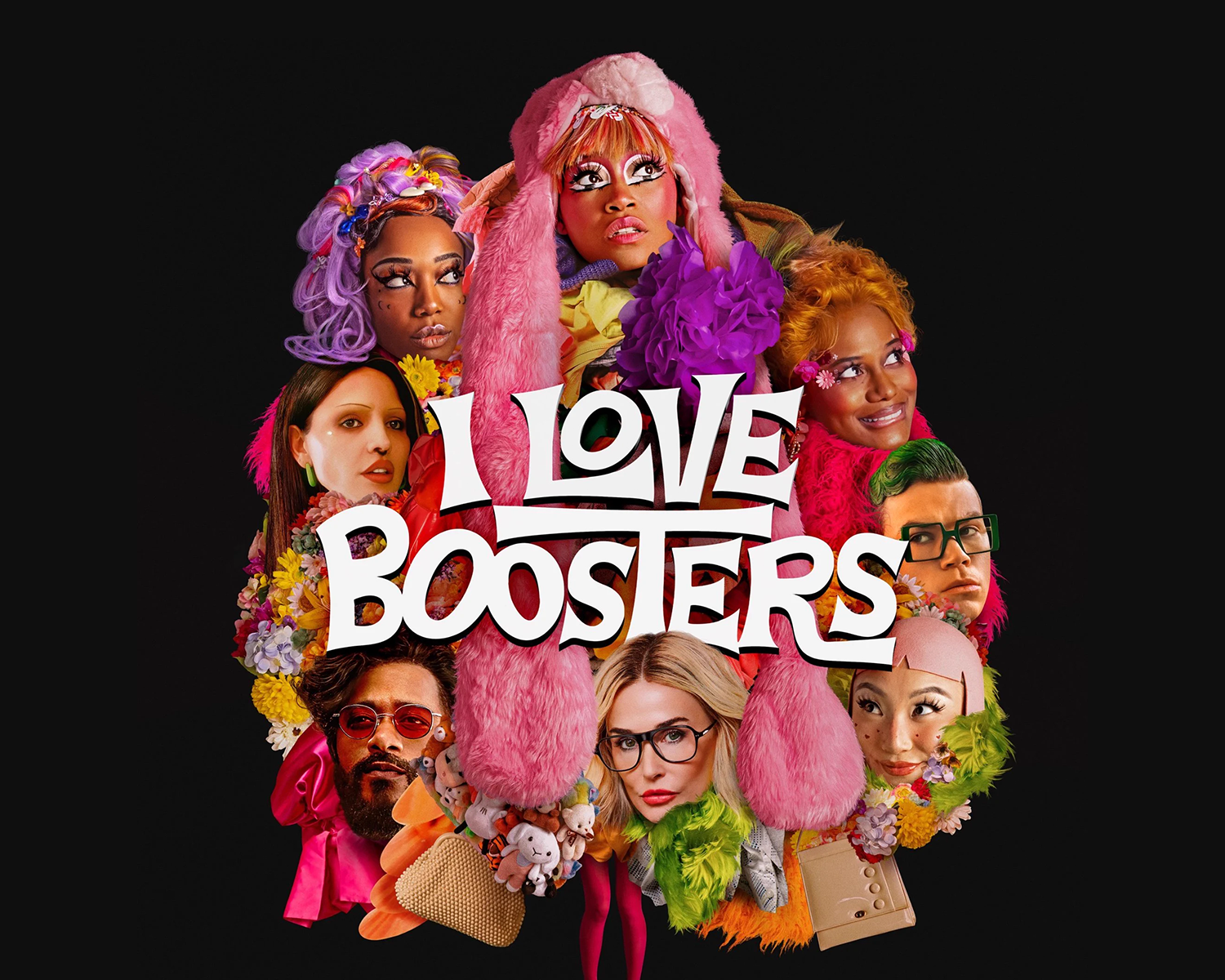
Promotional poster for I Love Boosters. Image property of Universal Pictures.
Back in 2017, social media made fashion settle on mustard yellow as the shade that "works" on Black skin. It sounded like praise, but it was really a glass ceiling: one colour handed over as permission. I never bought it, and I Love Boosters has finally given me the evidence.
Boots Riley dresses his film in the brightest colours that shouldn't get along—shades meant to clash when viewed through colour theory, shout and contradict each other—then puts them on Black women who wear every one of them like it was made for them. That's the thing Riley has mastered here. Black skin doesn't need a colour chart. It was always the whole palette.
In a film about fashion, at its core, it's about who has the means to create and access to fashion, who gets to wear the clothes and ultimately it matters more than you'd think. For anyone outside the US, some context: "boosting' is American slang for shoplifting, and a booster is someone who does it seriously: lifting designer stock and flipping it on for less. In Britain, we'd just call it spoofing. Riley names it as a calling.
His boosters are the Velvet Gang, with Keke Palmer's Corvette running the operation, with Naomi Ackie's Sade and Taylour Paige's Mariah alongside her, working the Bay Area shops. They've even given themselves a mission statement: "Fashion Forward Filanthropy". It's a joke at the expense of an industry that already launders exploitation from East Asia through good branding—if a label can call a sweatshop "heritage craftsmanship", why can't three women from Oakland call theft charity?
Their mark is a fashion empire headed by Demi Moore, who plays a one-dimensional, stiff executive who sells you the dream, then calls security when you reach for it. The gang's answer is blunt: seize the means of the production with a five-finger discount… and don't forget the handbags!
What starts as a caper doesn't stay one for long. If you've seen the 2018 surreal comedy Sorry to Bother You or the 2023 television show I'm a Virgo, you know Riley doesn't stay in one genre, or one dimension, for long. Buildings bend, the physics give up, and the bad guys turn out to be much stranger than bad bosses.
What I loved most is how much of the filmmaking comes from outside "proper" cinema. When the gang flees a heist, their legs pedal furiously in place like a Looney Tunes escape, going nowhere fast—about as honest a picture of the working class trying to get ahead as you'll find.
Stop-motion animatronics suddenly lurch into scenes, with handmade, uncanny mouth movements when they speak that no rendering software can copy. The cuts feel like they were made with safety scissors and a glue stick, and I mean that as a compliment. Riley has an eye for detail in his visual style, pulling from every corner of pop culture and stitching it into something entirely his own.
Then there's the sound. The repetition of "Hi-Ho" by Tune-Yards shows Riley's clever, constant use of non-diegetic sound—music and sound effects the characters can't hear—laid on purely for us. It's a running commentary. A tense moment deflates with a cartoon boing; a sincere one gets a sly musical wink. Merrill Garbus and Nate Brenner of Tune-Yards, who also scored Riley's debut, give it all a restless, rubber-band energy.
None of this is random. Satire works by holding up a distorted mirror, and when the real world already lets a corporation profit from underpaid labour while jailing someone for taking the finished product, a realistic film would be the dishonest one. The absurdity is how Riley tells the truth.
Riley has been in this argument for 20 years. The title is borrowed from "I Love Boosters!", a song on Pick a Bigger Weapon, the 2006 LP by his Oakland hip-hop group The Coup. The film is that song's thesis at feature length: shoplifting as a survival strategy, and survival as politics.
Watching it, I kept returning to Frantz Fanon. In The Wretched of the Earth, he describes the way the colonised look at the coloniser's world—with desire, but also with indictment. Corvette looks at Christie Smith's boutique window the same way. She isn't trying to become Moore's character. She wants access to what was walled off, and she wants the wall to look ridiculous. A stolen designer bag in her hands is no longer a luxury product; it's a seized asset, a redistributed means of production. Forget the trend reports. This season's must-have is revolution.
Natasha Braier's cinematography makes that fight visible. She films Oakland, Richmond, and Hayward with real affection, letting Riley's colours do the talking. Moore's world is sleek, sterile and colour-graded within an inch of its life. Corvette's is layered and gloriously mismatched. You know whose side the film is on before anyone opens their mouth.
Palmer carries it all effortlessly—sharp, funny, and believable even as everything around her unravels. But the moment that floored me wasn't a set piece. It was Corvette, almost in passing, admitting: "I'm even lonely when I'm with people."
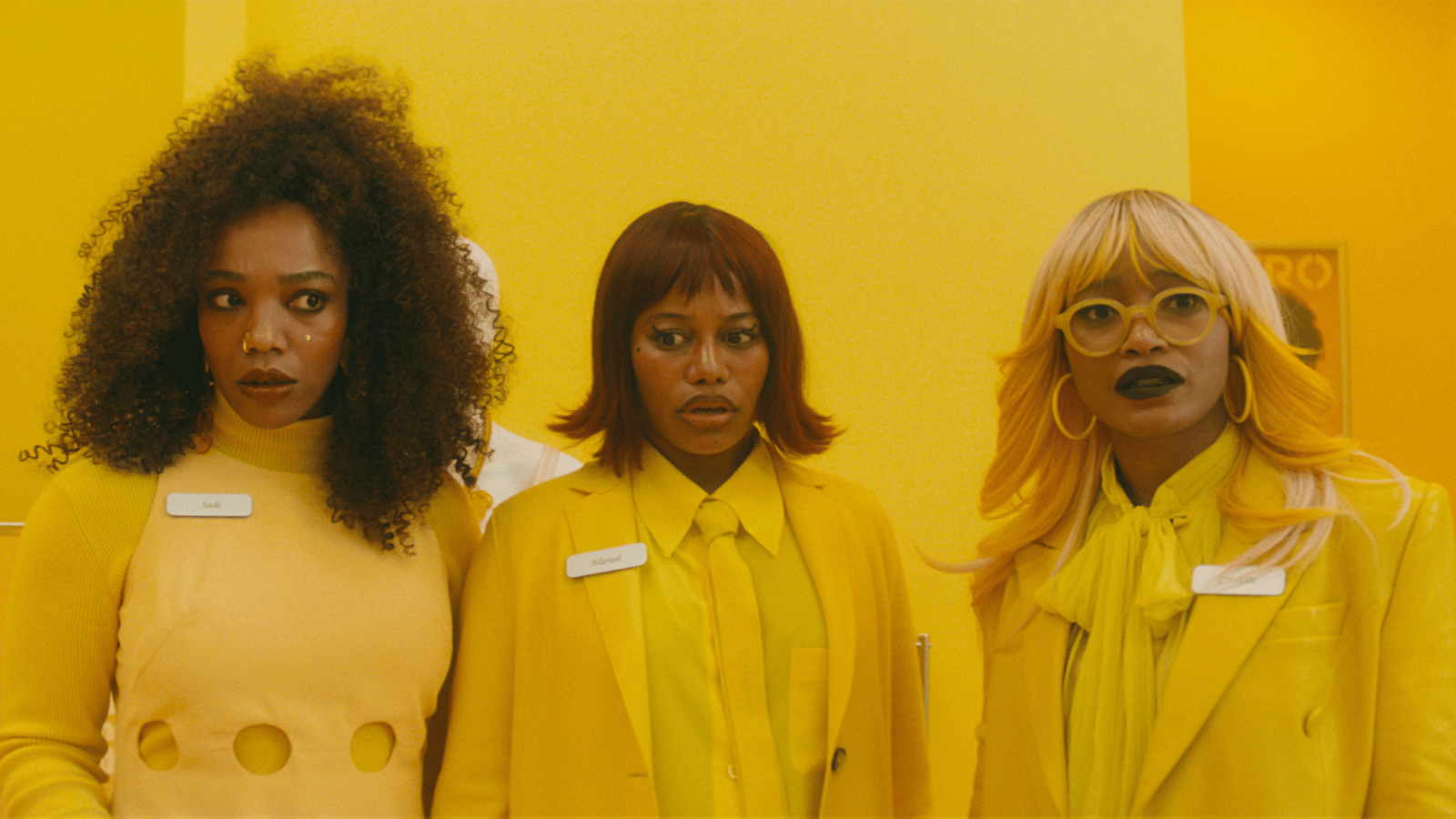
As someone watching, that line hit deeply. It names something rarely said out loud: the loneliness of wanting more for yourself while the people closest to you are chasing something else. Corvette isn't alone. She has a crew, a mission, a neighbourhood behind her. What she lacks is anyone travelling in the same direction, and Sade's slow drift away from her gives that feeling weight.
Anyone who's been in their 20s knows it. The friendships are still there; the goals just aren't the same anymore. Ackie plays it beautifully, even if the subplot gets too little space, and Paige gets even less. Still, Riley captures in one sentence what many films spend two hours circling.
So where does that leave me? I loved I Love Boosters for its sheer ingenuity—no other film this year sounds or looks like it. But I'd have loved it more if Riley had stopped to tie a few knots. The reveal that the man with the pinky ring is an alien deserved more than a shrug, and without spoiling the film, I left the cinema still wondering what became of Grayson. When a film throws this many ideas at the wall, some are bound to slide down. I just wish he'd gone back for a couple.
“Riley has made a heist film in which the stolen goods are dignity, colour, and a bit of joy.”
Even so, the loose ends are the cost of the ambition, and I'd take Riley's loose ends over most directors' neat bows. Riley has made a heist film in which the stolen goods are dignity, colour, and a bit of joy—he's smuggled the revolution out in a luxe shopping bag. At a preview screening ahead of the BFI London Film Festival, the room undoubtedly erupted with laughter and left with a pep in their step.
The new Boots Riley flick hits cinemas across the UK and Ireland on October 30th.