

Azur: How a D'Angelo and Jamiroquai Collaboration Became R&B's Greatest "What If"
A UK-born collaboration with ties to D'Angelo and Jamiroquai could have shaken up the '90s R&B scene, but was shelved for a decade. Now, nearly three decades later, this hidden gem is finally getting the shine it deserves.
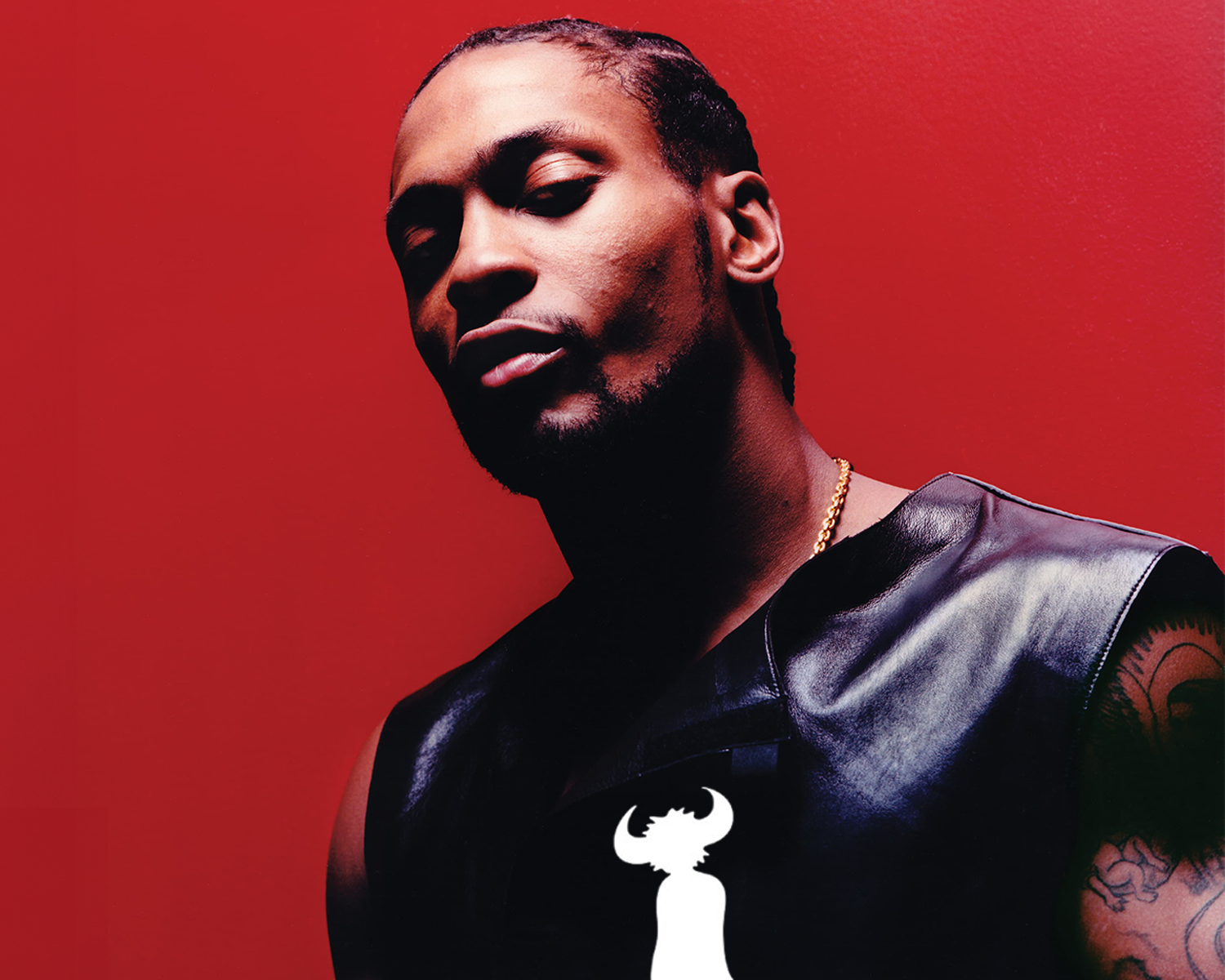
D'Angelo (with Jamiroquai's mascot tagging along) in 1995. Image property of Beth Herzhaft.
It's easy to think about music like how we think about history—it's infinitely consequential, a reference for our present and future, peppered with unsung heroes and razor-thin margins. Every album, song, or moment we've come to know and love is the result of an endless series of events. But when things don't happen, and possible sonic events fizzle into dust, we're left with one of the most powerful questions in the world: "What if?"
Like so many scrapped albums and short-lived acts, Azur is haunted by that question. Both the name of a supergroup and its lost album, Azur brought together singer-producer Don-E and Jamiroquai bassist Stuart Zender—two historically unsung stalwarts of UK R&B and soul. Don-E, the son of a preacher, has backed Grace Jones, James Brown and Lauryn Hill, among others, while Zender has played with the likes of Stevie Wonder and D'Angelo.
It was 1998. Don-E had parted ways with Island Records after releasing the albums Unbreakable in 1992 and Changing Seasons in 1995, choosing instead to sign with D'Angelo's record label. His debut spawned his biggest hit, "Love Makes the World Go Round", which vaulted its way to #18 on the UK Singles Chart. He was already an honorary Soulquarian at the time, singing, writing, and creating largely on his own, using his easy, dark, effortless vocals to his advantage in a way that invokes the likes of Raphael Saadiq or D'Angelo himself. He is a true crooner whose voice is another instrument in the orchestra inside his mind.
"My passion is music directly, from the day out, from my wake up, til I go to sleep," Don-E said in a 2010 interview. "It's straight up music … I can't think of anything else I'd be doing on planet earth. I think I want to end up like Quincy Jones, that's the template."
Zender, who had just made his exit from Jamiroquai after creative differences with lead singer Jay Kay, was allegedly signed to D'Angelo's label at the same (brief) time as Don-E. The Jamiroquai bassist was already lauded for his four albums of work with the band, most notably Travelling Without Moving, perhaps the group's most well-known work outside of the UK. He was already incredibly technically proficient—in the ilk of Jaco Pastorius while serving as a connection to the modern, Thundercat-adjacent bass-playing of today—all without being able to read music.
"I know a lot of classical people… they can't jam at all," Zender said of his inability to read music back in 2009. "When it comes time to improvise or just jam, they just can't do it without something in front of them. I think you can lose a lot in the technical side of things and gain a lot with just your ear and your heart."
For the next year or so, the two created a classic, full-throated, criminally underappreciated 10-song project. According to circulating blog accounts, the line-up was set to include D'Angelo, bassist Pino Palladino and a Cuban horn section, with the title track reportedly eyeballed as the lead single for spring 2000. But the album was shelved. The project wasn't publicly available until around 10 years after the duo finished it, and even that was short-lived.
If the folklore is to be believed, Virgin Records redirected promotional funding towards actor-singer Tyrese, a move said to have upset Zender. We explored the project on our social media in 2025 to much fanfare—before D'Angelo's untimely passing—with both Zender and Don-E commenting on the post. Their engagement lent further credibility to the scraps of history we'd pieced together, although it didn't confirm the precise circumstances behind the shelving.
Believe the hype. Azur (fan-made track titles and all) is a hidden gem buried deep within the landscape of Black music—particularly in the realms of soul and funk. The album has it all: the production is as strong as it is eclectic and unpredictable. Its weakest elements are moments of commendable risk-taking and unconventionality, even if they don't work for you personally. Its strongest elements absolutely stop you where you're standing. Two men in their mid-20s created an album that only began circulating around a decade later; now, more than 15 years after those early uploads—it's finding another audience.
The version of Azur I listened to began with "Baby I've Got to Know", an easygoing track that allows Zender and Don-E to quickly prove their soul music bona fides. Don-E and Zender sound like they're barely trying here, producing an opening track that rivals any other sound at the time. It sounds like something I'd hear my father playing at home, something he'd turn to me and ask, "What do you know about this?" It's a high-level, high-production classic that I have no doubt would have been widely appreciated if given a fair shot on the market side.
The next two tracks, "Say I Want You" and "Azur (Az U R)", maintain that high quality, thoughtful soul. The percussion pockets are tight, and Don-E and Zender weave in and out of them with relative ease. "Azur" is a much funkier, brighter song than the previous two that has a lovely rap verse closer to the end, although the rapper is unknown to me.
The next track, "Suddenly", immediately grabbed my face, plunging me into a combination of hardcore breakbeats, merging seamlessly with Don-E's vocals and Zender's heavy bass. Hardcore breakbeats aren't something my Black American ears grew up listening to, and it's obvious I was missing out. This moment is so '90s, so essentially UK, and still somehow extremely soulful. It's a small taste of the range and risk the album offers.
The next track, smack dab in the middle of the album, is "Love Is So", featuring D'Angelo on Fender Rhodes, bending the instrument to his will. According to the blogs, the track was initially slated to appear on his second album, Voodoo, under the title "My Baby's Eyes", although—like much of the history surrounding Azur—confirmation is shaky at best. Still, the track's a slow, full-fat, sugary groove that you ought to dim the lights for. One of the project's more recognisably Soulquarian-sounding tracks, it serves as a shining beacon at the album's midpoint, with D'Angelo's measured, jazzy playing providing a rich underpinning for Don-E's vocals. Arguably the best-known song beyond Azur's cult following, it later resurfaced on Don-E's 2008 LP Natural under the title "So Cold".
The sixth and seventh tracks, "Anything to Make it Through" and "All These Things Remind Me", offer a more slice-of-life element, as Don-E laments the grind ("9 to 5, trying to stay alive") and lost love that he can't seem to get out of his head. "Get to Heaven" is another ambitious production, this time implementing breakbeats over a more West Coast feel. It's also the group's most interesting lyrical moment, as Don-E alternates between wanting to "get to heaven" and realising that he's already in a "ghetto heaven" here on earth. The album closes out in a mellow, satisfying way with "Sunshine" and "Picture in My Heart".
“It’s impossible not to think of how much history is lost to studio sessions, to contract disputes, to egos, to technicalities, to inconveniences. That’s what makes that question of ‘what if?’ so enticing, so natural to raise.”
Azur is sensual and confidently aimless, both nonchalant and yearning for freedom, love and peace. It's baffling that this album collected dust for a decade before circulating through blog uploads and tracks shared on Zender's MySpace (though recent YouTube uploads have since been removed following copyright claims attributed to Zender). While the precise reasons for its shelving remain unclear, it's impossible not to think of how much history is lost to studio sessions, to contract disputes, to egos, to technicalities, to inconveniences. That's what makes that question of "what if?" so enticing, so natural to raise.
And yet we have Azur now, and we still have the two men who created it, even as their collaborators and inspirations have passed on, like they and everyone else very well will one day. A hidden gem is still a gem. I implore you to gaze upon it if you get the chance.
Listen to Azur here.